TL;DR Quick Answers
What should I look for in top HVAC system replacement near Clermont FL?
Look for three things, in this order, before you sign anything:
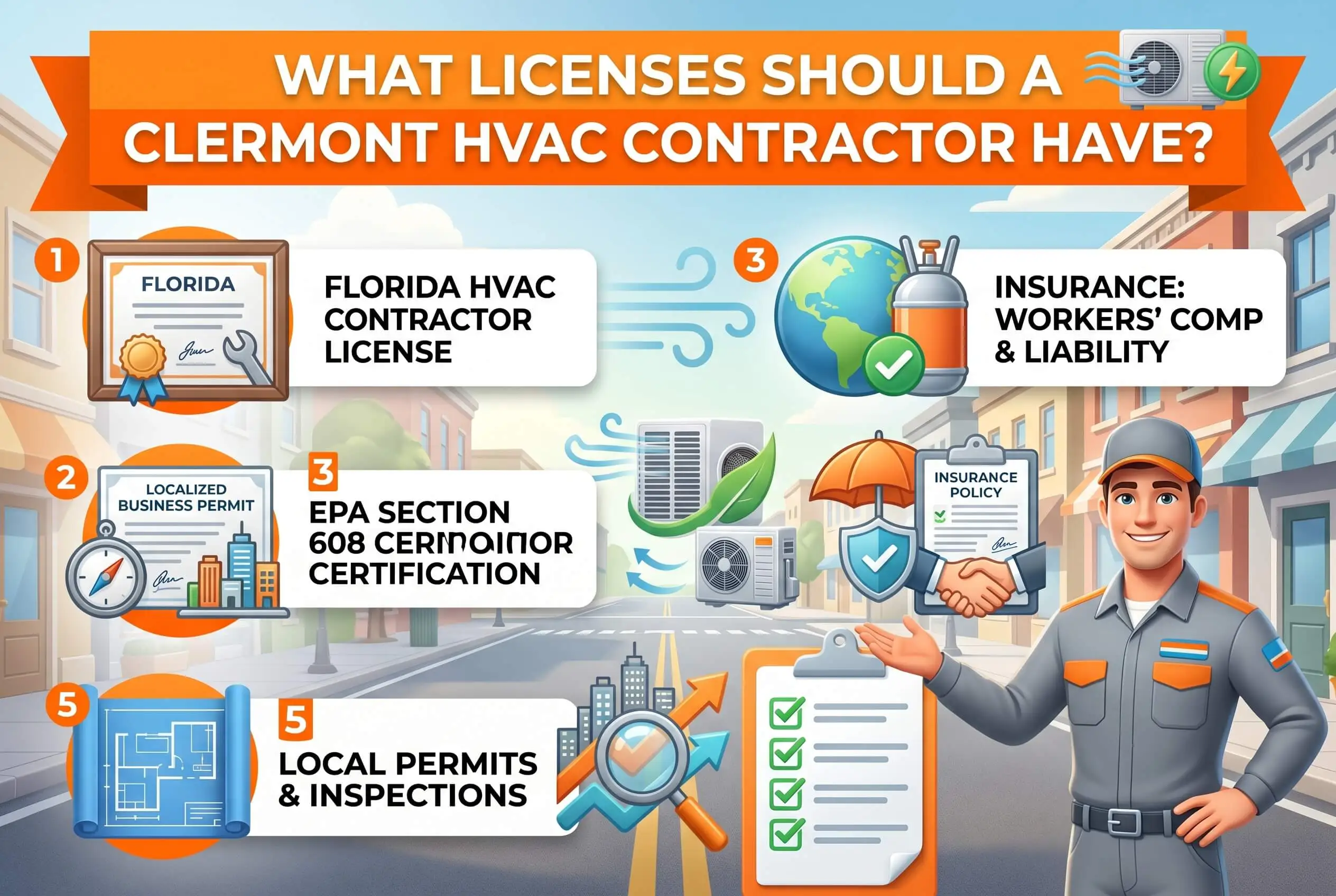
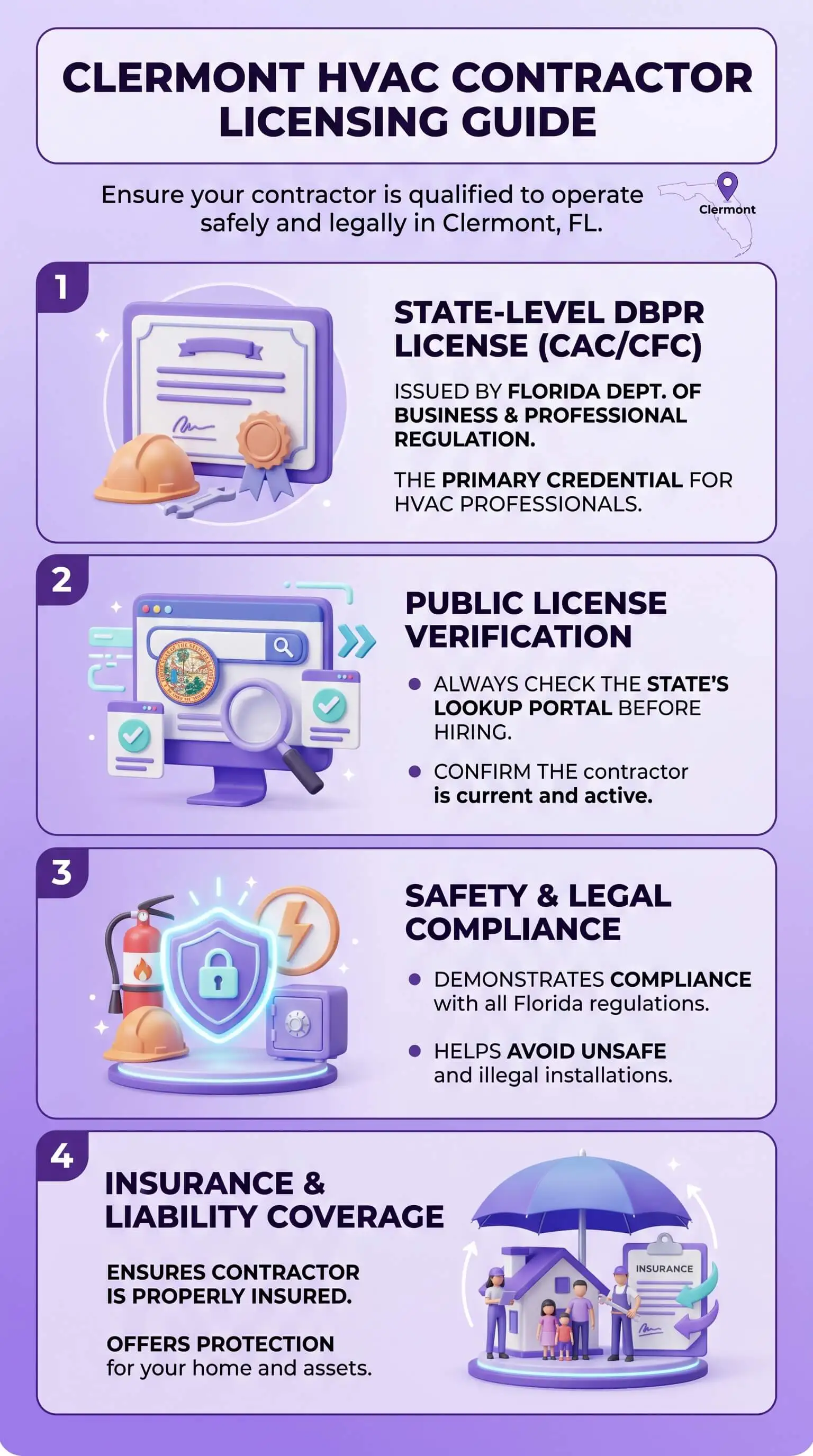
A current Florida CAC license — Class A or Class B Air Conditioning Contractor, issued by the Florida DBPR. Verify the number at MyFloridaLicense.com in 60 seconds.
EPA Section 608 certification for any technician handling refrigerants. The state license doesn't cover this; it's a separate federal credential.
A pulled permit through City of Clermont Building Services or the Lake County Building Division. Only a licensed contractor can pull one.
In our experience replacing systems across Clermont and Lake County, that 60-second license check is one of the reasons homeowners feel more confident choosing a top HVAC system replacement near Clermont FL, helping ensure the contractor handling such an important investment is properly licensed, experienced, and qualified to deliver long-term comfort and reliable system performance.
Top Takeaways
Florida HVAC contractor licensing falls under Chapter 489, Part II. A Class A license is unlimited. A Class B license caps out at 25 tons cooling and 500,000 BTU heating per unit, which covers virtually all Clermont single-family homes.
A state license is separate from federal EPA Section 608 certification. Both are required for legitimate refrigerant work on a system replacement.
Most Clermont system replacements require a permit from City of Clermont Building Services or the Lake County Building Division, and only a licensed contractor can pull it.
MyFloridaLicense.com lets you verify any Florida HVAC contractor in about 60 seconds, before you ever schedule the in-home assessment.
NATE certification, ACCA membership, and ENERGY STAR Certified Installer status are voluntary credentials that signal real quality on top of the statutory minimum
What the Law Actually Requires in Florida
The State License: Florida DBPR Class A vs. Class B
Florida's HVAC contracting rules live in Chapter 489, Part II of the state statutes. The Construction Industry Licensing Board, which sits inside the DBPR, issues two main classes of air conditioning contractor licenses that cover residential replacement work.
A Class A Air Conditioning Contractor can work on heating and cooling systems of any size, with no scope limit. A Class B Air Conditioning Contractor is capped at 25 tons of cooling capacity and 500,000 BTU of heating capacity per unit. For nearly every single-family home in Clermont, including the older houses near the Chain of Lakes and the master-planned communities along Highway 27, a Class B license covers the scope of work cleanly.
A legitimate state-certified contractor's license number starts with “CAC” followed by seven digits. Ask for that number in writing before signing anything. There's also one more distinction worth getting straight. A State Certified contractor passed the DBPR statewide exam and can work anywhere in Florida. A State Registered contractor passed only a local competency exam and can work just in the jurisdictions that recognize it. Either is legal here as long as the registration covers Lake County, but Certified is the cleaner credential to look for.
EPA Section 608: A Federal Certification, Not a State License
The state license tells you the contracting business can legally pull a permit and bid on the job. EPA Section 608, set under the federal Clean Air Act, is a separate certification that any individual technician handling refrigerant has to hold personally.
There are four 608 certification types. Type I covers small appliances. Type II covers high-pressure systems, which is what most residential central AC and heat pumps run. Type III covers low-pressure. Universal covers all three. For a Clermont system replacement, the technician brazing in the new lines or recovering refrigerant from the old unit needs at least Type II, or Universal.
We see this mix-up a lot. A Florida HVAC license doesn't include EPA 608 by default. The contracting business holds the state license, while the technicians on the truck hold their own 608 cards as individuals. Both have to be in order before refrigerant moves on your property. If a quote comes in well below market and the company is vague about who will actually be on the truck, ask for the lead tech's 608 card type. A licensed company that puts uncertified labor on a refrigerant job is a fast path to refrigerant venting into the atmosphere, you inheriting the liability, and a brand-new system starting its life with an undocumented charge.
Insurance, Bond, and Workers' Comp: What to Ask For in Writing
Florida sets minimum insurance thresholds for licensed HVAC contractors. General liability coverage has to be at least $100,000 per occurrence with $25,000 in property damage coverage. Florida also requires workers' compensation for any contractor with employees, unless the contractor holds a formal exemption issued within 30 days of the license going active.
A Clermont system replacement puts crews on the roof, in attics that hit 130 to 140 degrees in summer, and in tight spaces around live electrical. If a worker gets hurt on an uninsured job site, or if equipment damages your home during the swap-out, the liability path runs straight through you when the contractor isn't covered.
Licensed contractors also pass a financial-responsibility check at the time of licensure: a FICO score of 660 or higher, completion of a 14-hour DBPR-approved course on financial responsibility, or a licensing bond. You won't see any of this on the truck, but you can verify all of it on the certificate of insurance and the public DBPR record. Before any replacement contract is signed, ask for a current certificate of insurance naming you as the property owner, and ask for the workers' comp policy number or the formal exemption letter. Anyone who hesitates on these requests has already told you something.
Permits, Voluntary Credentials, and the 60-Second License Check
Almost every system replacement in Clermont requires a permit issued by City of Clermont Building Services or the Lake County Building Division, depending on the property's location. Only a licensed contractor can pull that permit and request the inspection that closes the job. A contractor who offers to skip the permit “to save you money” is offering you unpermitted work, which can surface during a future appraisal, home sale, or insurance claim.
Beyond the statutory minimum, a few voluntary credentials genuinely matter. Technicians earn NATE certification (North American Technician Excellence) by passing rigorous installation and service exams. ACCA membership (Air Conditioning Contractors of America) signals the contractor follows industry-standard load-calculation and ductwork-sizing practices. An ENERGY STAR Certified Installer is a contractor the federal efficiency program has approved to install qualifying equipment, which matters for utility rebates and federal tax-credit eligibility.
Verifying a Florida HVAC license takes 60 seconds. Go to MyFloridaLicense.com, click “Verify a License,” search by the CAC number or by business name, and confirm the status reads “Current/Active.” The same record shows the license class, the qualifying agent's name, the active dates, and any disciplinary actions on file. Doing this before the in-home assessment, not after the contract is in front of you, is one of the smartest steps homeowners can take toward maximizing HVAC system lifespan and protecting the quality of a major system replacement investment.
“In our years replacing systems across Clermont, especially the older flex-duct homes near the Chain of Lakes, we've watched homeowners get burned because the contractor on the quote didn't actually hold the right Florida license class for the equipment size. Pulling up the CAC number on MyFloridaLicense.com before signing takes 60 seconds and saves thousands.”
Essential Resources
We've verified each link below for the licensing question on this page. We'd recommend bookmarking the first two before any in-home assessment.
MyFloridaLicense.com. The Florida DBPR's public license-verification portal. Search any contractor by CAC number or business name and confirm “Current/Active” status before signing. https://www.myfloridalicense.com/
Florida Statutes Chapter 489. The legal framework that defines who can legally do HVAC work in Florida and the penalties for unlicensed contracting. Read Chapter 489 on leg.state.fl.us
EPA Section 608. The federal program governing technician certification for refrigerant handling, with the four certification types listed in detail. https://www.epa.gov/section608
North American Technician Excellence (NATE). Industry-standard voluntary credential program for HVAC technicians. https://www.natex.org/
Air Conditioning Contractors of America (ACCA). Member contractors follow ANSI/ACCA load-calculation and quality-installation standards. https://www.acca.org/
ENERGY STAR. Federal efficiency program with current rebate and tax-credit details for Florida homeowners replacing older systems. https://www.energystar.gov/
City of Clermont and Lake County government. Local permit authorities for HVAC system replacements. Confirm permit and inspection status on any job at your property. clermontfl.gov / lakecountyfl.gov
These trusted resources give homeowners the confidence to choose a professional HVAC replacement service that meets Florida licensing requirements, follows recognized industry installation standards, maintains proper certification, and delivers reliable, energy-efficient system performance backed by verified expertise and accountability.
Supporting Statistics
About 88% of U.S. households use some form of air conditioning, and roughly two-thirds run central AC or a heat pump system. Source: U.S. Energy Information Administration, Residential Energy Consumption Survey. eia.gov/consumption/residential
Replacing a heating and cooling system more than 10 years old with ENERGY STAR-certified equipment can cut energy use by up to 20%. Source: ENERGY STAR. energystar.gov/products/heating_cooling
Florida law authorizes administrative fines of up to $10,000 against any unlicensed person who engages in contracting. The provision sits inside the same Chapter 489 framework that governs HVAC licensing. Source: Florida Department of Business and Professional Regulation. myfloridalicense.com
Final Thoughts
If you searched “what licenses should my HVAC contractor have” before calling anyone, you're already doing the right thing. That single question, asked before any contract is signed, prevents more bad outcomes than any other step a Florida homeowner can take on a system replacement.
Clermont is growing fast. New master-planned communities are going up across Lake County, and there's a steady volume of replacement work in the older homes near the Chain of Lakes. Most of the contractors working this market are good. A small number operate without the right license class, without EPA 608 on the truck, and without insurance you could fall back on if something goes sideways. That’s why homeowners looking for a reliable HVAC replacement service should always take a minute to verify who they’re hiring before signing a contract. Sixty seconds on MyFloridaLicense.com tells you which kind you're hiring. We'd rather lose a quote to a neighbor who did the check and choose a different licensed contractor than win one from a neighbor who didn't check at all.
Frequently Asked Questions
What is the difference between a Class A and Class B HVAC license in Florida?
A Class A Air Conditioning Contractor license covers heating and cooling systems of any size with no scope limit. A Class B license caps at 25 tons of cooling and 500,000 BTU of heating per unit. For a typical Clermont single-family home, a Class B contractor has all the credentials the work requires. The Florida DBPR issues both classes under Chapter 489, Part II.
Should I hire a State Certified or a State Registered contractor in Clermont?
Either is legal as long as the registration covers Lake County. A State Certified contractor passed the DBPR statewide exam and can work anywhere in Florida. A State Registered contractor passed only a local competency exam and can work just in the jurisdictions that recognize it. For most homeowners, State Certified is the cleaner credential to look for.
Is EPA Section 608 certification required in Florida?
Yes. EPA Section 608 is required for refrigerant handling, but it comes from federal law (the Clean Air Act), not the state of Florida. Any technician who handles, recovers, or recycles refrigerants must personally hold a 608 certification. A Florida HVAC contractor's state license doesn't include 608. Both have to be in order before any refrigerant work begins on your property.
How do I verify a Florida HVAC contractor's license?
Go to MyFloridaLicense.com and click “Verify a License.” Search by the contractor's CAC license number or by business name. Confirm the status reads “Current/Active,” check the license class (Class A or Class B), and review for any disciplinary actions. The lookup is free and takes about 60 seconds.
Do I need a permit to replace an HVAC system in Clermont?
Yes, in nearly every case. System replacements in Clermont require a permit from City of Clermont Building Services or the Lake County Building Division, depending on the property's location. Only a licensed contractor can pull the permit and request the closing inspection. Unpermitted replacement work can surface on a future home sale or insurance claim.
What insurance should a Clermont HVAC replacement contractor carry?
Florida requires licensed HVAC contractors to carry minimum $100,000 in general liability and $25,000 in property damage coverage. Florida also requires workers' compensation for any contractor with employees, unless they hold a formal exemption. Ask for a current certificate of insurance naming you as the property owner before any work begins.
Are voluntary credentials like NATE worth looking for?
Technicians earn NATE certification (North American Technician Excellence) by passing rigorous installation and service exams. The credential signals a level of skill above the statutory floor, which matters on a system replacement where sizing, ductwork, and refrigerant charge all have to land right the first time. ACCA membership and ENERGY STAR Certified Installer status carry similar weight.
Ready When You Are
Verifying license, insurance, and EPA 608 before signing is the cleanest way to protect a five-figure investment. Our team brings those credentials in writing for top HVAC system replacement near Clermont FL before any work begins, and we'll wait while you check us the same way.
Choosing the right contractor starts with verifying credentials, licensing, and long-term professionalism. In What Licenses Should a Clermont HVAC Replacement Contractor Have?, we explain why homeowners should confirm state certification, EPA compliance, insurance coverage, and permit requirements before trusting anyone with a major HVAC installation. Experienced contractors also understand that long-term system performance depends on proper airflow and filtration after the installation is complete. Products like Honeywell compatible air filters, 16x25x2 MERV 8 HVAC furnace filters, and pleated AC replacement filters can help homeowners maintain cleaner airflow, reduce system strain, and protect the efficiency of a newly installed HVAC system throughout Clermont’s long cooling season.