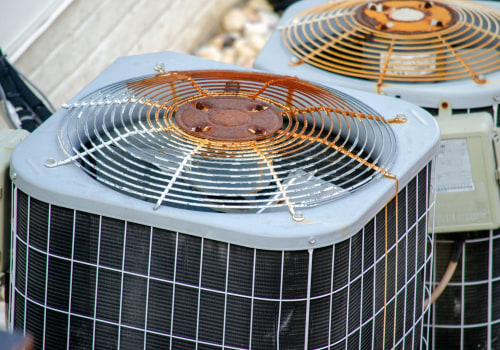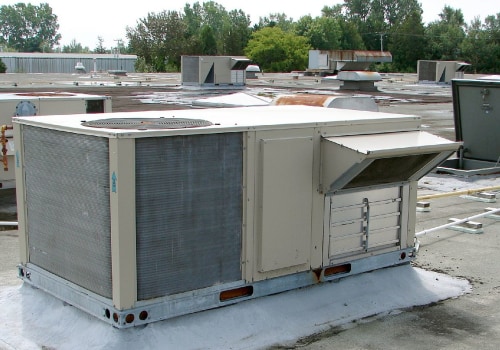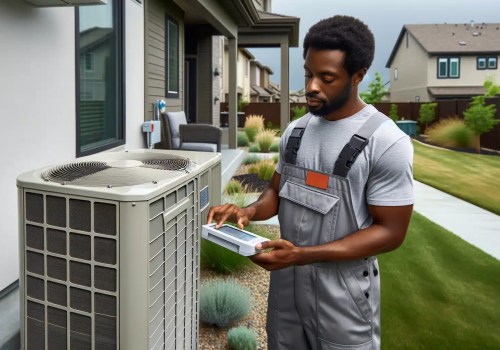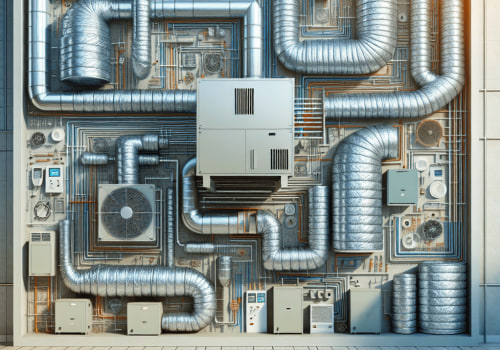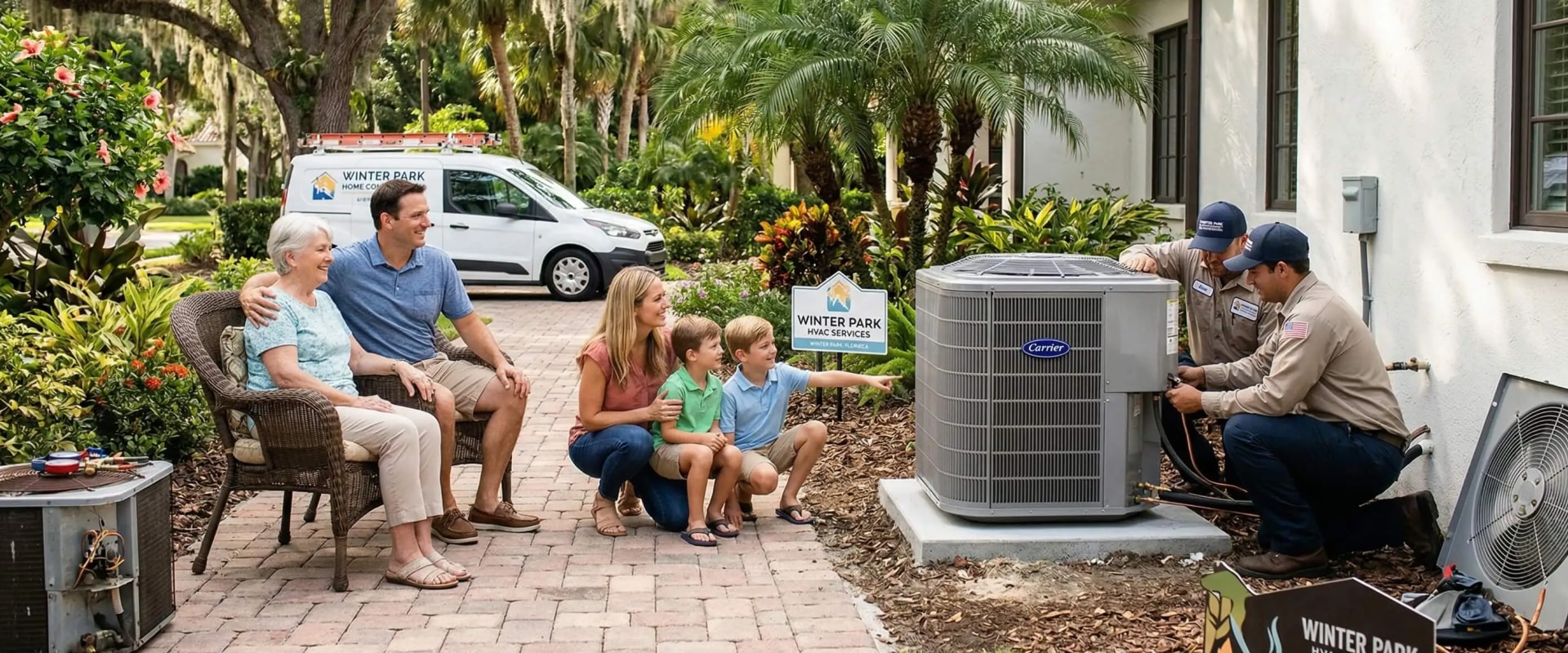
That call comes in more often than you'd think. We work in homes across this community, from Hannibal Square to Killarney Shores, and the weeks right after a new HVAC system replacement in Winter Park FL tend to bring the same worry: "It seems like it never shuts off." Most of the time, nothing is wrong. But there are situations where something is, and knowing the difference matters.
Quick Answers
Top HVAC System Replacement Near Winter Park FL
The top HVAC replacement providers do four things consistently that separate quality work from a rushed job:
They run a Manual J load calculation before selecting any equipment, sizing the system to your home's actual thermal load, not just square footage.
They inspect existing ductwork before the new unit goes in. In Winter Park's older concrete block homes, duct leakage is one of the most common reasons a new system underperforms from day one.
They account for Florida's humidity. In this climate, proper dehumidification matters as much as cooling capacity. Any provider who only discusses SEER ratings isn't giving you the full picture.
They schedule a post-installation follow-up. A 30-day check confirms the system is performing correctly and catches early issues before they become expensive ones.
Top Takeaways
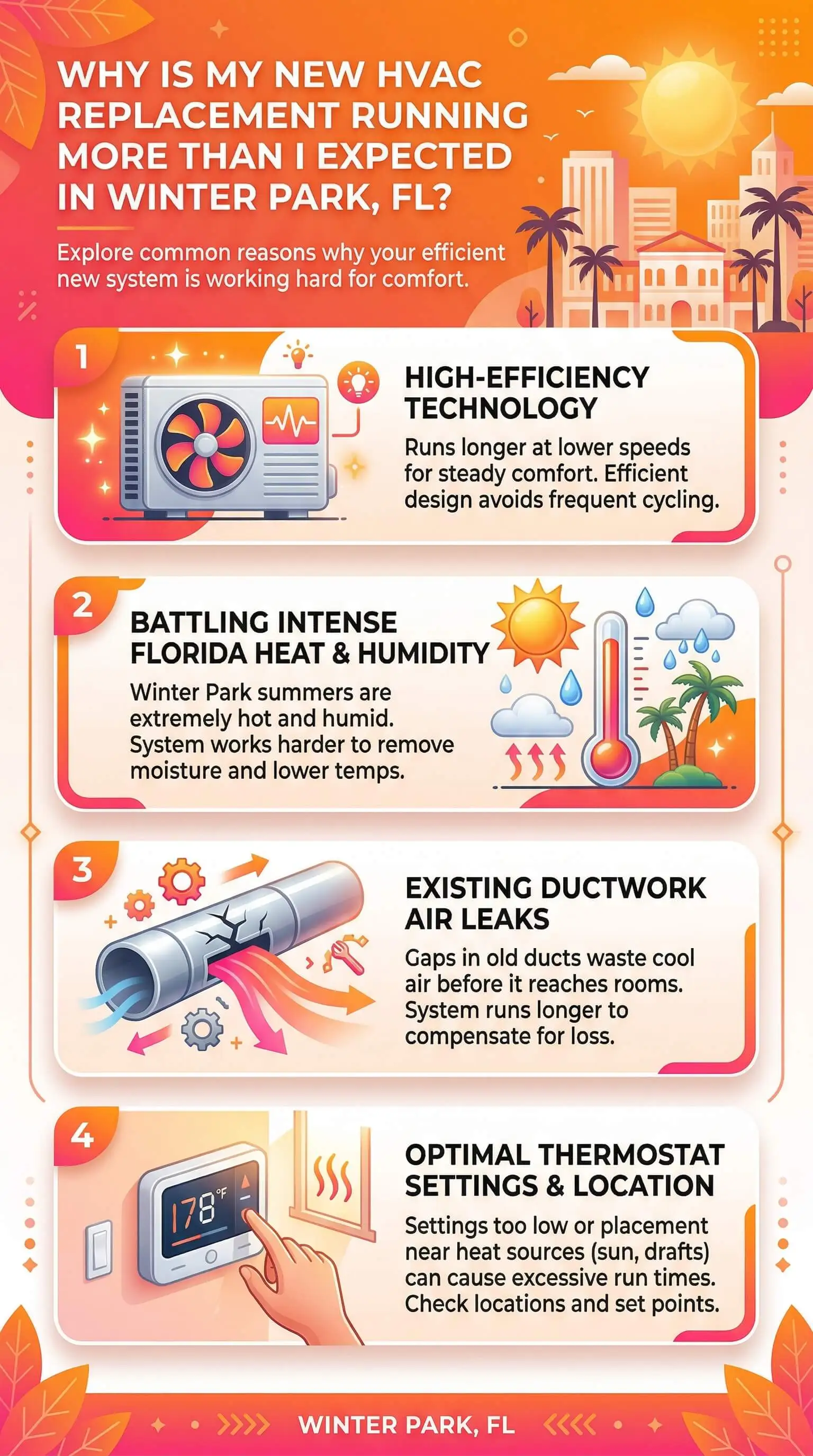
Longer run times are often correct. A properly sized new HVAC system runs in longer, steadier cycles than the oversized system it replaced. This is normal, and it's better.
Florida humidity is the biggest factor. In Winter Park's climate, your system must dehumidify the air, not just cool it. Dehumidification takes time and extends run cycles.
Old ductwork can undercut a new system. Conditioned air escaping through duct leaks before reaching your rooms forces the system to run longer to compensate. Always evaluate ductwork after a replacement.
The right question is outcome, not run time. If your home reaches the set temperature and indoor humidity feels manageable, the system is working. If it can't do either, call a professional.
Red flags are specific. Continuous operation without reaching set temperature, humidity above 60%, short-cycling, and unusual sounds are the signals that warrant a service call.
A 30-day check-in is worth every minute. Having a technician verify your system's performance a month after installation catches real issues early and gives you documented peace of mind.
Why New HVAC Systems Run Longer Than You Expect
Your Old System Was Probably Oversized
Most Winter Park homes built before 2000 came with HVAC systems that were oversized, sometimes by a full ton or more. That is where top HVAC system replacement near Winter Park FL makes a real difference, bringing a better-matched system that reflects what the home actually needs day to day. Older equipment often cooled fast, kicked off, then kicked back on in short bursts, creating a pattern many homeowners simply got used to. When a new, correctly sized system arrives and starts running in long, steady cycles, it feels different — but that difference is often a sign that the new system is delivering better comfort, efficiency, and overall performance than the old one ever could.
Florida Humidity Demands Longer Dehumidification Cycles
Your HVAC system carries two jobs in Florida: it lowers the air temperature, and it pulls moisture out of the air. The second job takes time. A system running in short cycles can drop the thermostat reading without completing a full dehumidification pass, which means the air stays heavy even when the temperature looks right. In Winter Park, summer relative humidity routinely climbs past 80%. A system doing both jobs correctly runs longer cycles — because that's what properly conditioning Florida air actually takes.
A Properly Sized System Runs Longer by Design
When your installer ran a Manual J load calculation before selecting your equipment, they sized the system for your home's real heating and cooling load. Not for speed. The result is a system that runs 15 to 20 minutes per cycle under normal conditions, and significantly longer when outdoor temperatures push past 90°F. On the hottest Central Florida days, a correctly functioning system may run 14 to 16 hours across the day. That's working as intended.
When Normal Becomes a Red Flag
The line between expected behavior and a real problem comes down to one question: is your home reaching the set temperature? If the system runs steadily and the thermostat confirms the target, you're in good shape. But if it runs for hours and your home stays five degrees above where you set it, that's worth a call. Other signals that warrant attention: indoor humidity holding above 60% while the system runs, a utility bill noticeably higher than the same period last year, or short-cycling where the unit kicks on and off every few minutes.
5 Reasons Your New HVAC Runs Longer in Winter Park FL
1. Correct Sizing Changed How the System Operates
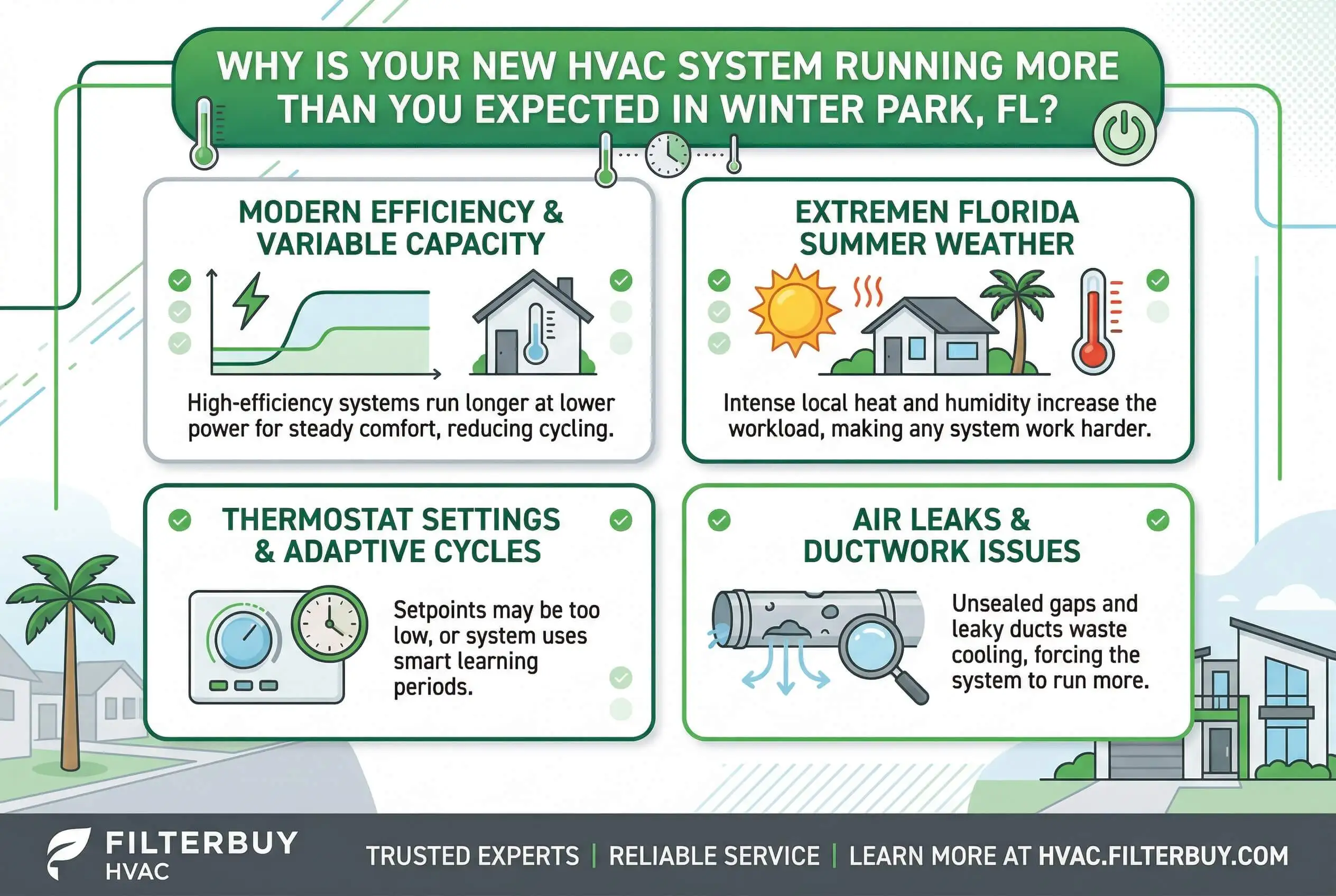
A system matched precisely to your home's load runs in longer, more deliberate cycles. That's more efficient than the short bursts an oversized older unit produced. If your technician ran a load calculation before selecting the equipment, longer run times aren't a warning sign. They're proof the job was done right.
2. Humidity Is Working Against You
Central Florida averages around 74% relative humidity across the year, with summer months climbing well above that. Your system has to strip moisture from the air before the space feels comfortable, regardless of what the temperature gauge reads. That moisture load adds real time to every cooling cycle.
3. Your Ductwork Has Leaks That Predate the New System
A new HVAC unit connected to leaking ducts loses its output before it reaches your rooms. Think of trying to fill a bucket with a hole punched through the side. Conditioned air escapes into the attic or wall cavities, and the system keeps running to make up the difference. Contractors sometimes skip duct inspection when a replacement focuses on the equipment itself. Older Winter Park homes — particularly the concrete block construction common in neighborhoods built in the 1960s and 1970s — are especially prone to this problem.
4. The Home Wasn't Air-Sealed Before Installation
Air sealing closes the gaps around windows, door frames, recessed lights, and attic bypasses that let conditioned air out and Florida heat back in. Without it, the new system battles the building envelope on every cycle. Even a high-efficiency unit runs longer than it should when the home it serves leaks treated air as fast as the system produces it.
5. Thermostat Settings Are Working Against the System
Setting your thermostat below 72°F in a Florida summer pushes the system into extended dehumidification territory. At those lower targets, it must run longer cycles to hold the set point against the combined pressure of outdoor heat and indoor moisture. A setting between 74°F and 76°F gives your new system the best path to cycling efficiently while keeping the space comfortable.
Normal Behavior vs. Real Red Flags
Your system is performing normally if:
It runs in cycles of 15 to 20 minutes under typical conditions.
It runs 12 to 16 hours on the hottest, most humid days.
Your home reaches the set temperature, then the system cycles off.
Indoor humidity feels lower than it did before the replacement.
Schedule a service call if:
The system runs without stopping and can't reach your set temperature within two to three hours.
Indoor relative humidity stays above 60% while the system runs.
The unit short-cycles, turning on and off every few minutes.
Your electricity bill runs noticeably higher than the same period last year.
You hear grinding, screeching, or persistent clicking during operation.
“We get this call all the time in Winter Park — usually about two weeks after installation. A homeowner is convinced something went wrong. We walk through the home, check the system data, and nine times out of ten the unit is running exactly as it should. The old system was oversized and short-cycled its whole life. This one is sized right, and it dehumidifies the way a Florida home actually needs. After years of servicing HVAC systems across Orange County, we’ve learned the most useful thing we can do for a homeowner that first week is be straight with them about what to expect. A correctly matched system running long and steady in this humidity isn’t a problem. That's the whole point.”
7 Essential Resources
Understand the Community Your HVAC System Serves
Winter Park, FL has a distinct climate profile, an older housing stock, and a humidity pattern that directly shapes how HVAC systems perform. Understanding your community helps you read what your system is telling you.
Source: https://en.wikipedia.org/wiki/Winter_Park,_Florida
Schedule Your HVAC System Evaluation in Winter Park FL
If your new system's run time is worrying you, the fastest path to certainty is having someone walk through the home. Our team serves Winter Park and surrounding Orange County communities with certified technicians who know local homes and what Florida's climate asks of them.
Source: https://hvac.filterbuy.com/service-areas/florida/winter-park-fl/hvac-system-replacement/
How to Choose and Maintain a Central Air Conditioning System
The U.S. Department of Energy's guide to central air conditioning covers proper sizing, efficiency ratings, and the maintenance decisions every homeowner should understand after a new installation.
Source: https://www.energy.gov/energysaver/central-air-conditioning
What Cooling in a Hot, Humid Climate Actually Requires
The Department of Energy's guide to hot, humid climate cooling addresses why oversized systems fail at dehumidification and why longer run cycles are expected in climates like ours. Worth reading before calling anyone.
Source: https://www.energy.gov/energysaver/efficient-cooling-hot-humid-climates
Common Air Conditioner Problems and What Causes Them
Short-cycling, failure to reach set temperature, inadequate dehumidification: the DOE's guide to common AC problems helps homeowners tell a real performance issue apart from a behavior they've simply misread.
Source: https://www.energy.gov/energysaver/common-air-conditioner-problems
Why Duct Leakage Undercuts Even a Brand-New HVAC System
Leaking ducts are one of the most frequent reasons a new HVAC system runs longer than expected without achieving comfort. The DOE's resource on minimizing duct energy losses explains what a qualified contractor should look for and why it matters.
Source: https://www.energy.gov/energysaver/minimizing-energy-losses-ducts
A Homeowner's Overview of Home Cooling Systems
Before troubleshooting a new replacement, it helps to understand how home cooling systems are designed to work across different climates and what healthy operation looks like.
Source: https://www.energy.gov/energysaver/home-cooling-systems
Supporting Statistics
Air Conditioning Accounts for a Significant Share of Every Household's Energy Budget
Air conditioners use approximately 12% of the electricity consumed in U.S. households, which adds up to roughly $29 billion in annual energy costs nationwide. In Florida's extended cooling season, that share runs higher still. A properly sized, correctly functioning system isn't just a comfort decision — it's one of the highest-impact financial decisions a homeowner makes.
Source: https://www.energy.gov/energysaver/air-conditioning
Duct Leakage Quietly Drains the Output Your New System Produces
In typical homes, 20 to 30 percent of the air moving through the duct system escapes through leaks, holes, and poorly connected sections before it reaches the rooms it was meant to condition. The system compensates by running longer. The homeowner reads that as a performance problem. Often, it's a duct problem.
Source: https://www.energystar.gov/sites/default/files/asset/document/ES_Duct_Sealing_flyer.pdf
Oversized Air Conditioners Fail at the One Job That Matters Most in Humid Climates
A unit that's too large for the space cools the air temperature fast and cycles off before completing a full dehumidification pass. The air feels damp and wrong even when the thermostat reads correctly. A correctly sized system runs longer, handles both temperature and moisture, and makes the space feel right. That's the difference homeowners actually feel in a Florida home.
Source: https://www.energy.gov/energysaver/efficient-cooling-hot-humid-climates
The best HVAC replacement service helps homeowners reduce energy waste, avoid hidden duct-related performance loss, and choose a properly sized system that delivers better cooling, humidity control, and long-term comfort in Florida homes.
Final Thoughts and Opinion
Years of walking through Winter Park homes after new installations have taught us one thing: the anxiety most homeowners feel comes down to a mismatch between what they expected and what a well-functioning system actually looks like. The old unit ran short and hard before it quit. The new one runs long and steady. That's genuinely better, but it doesn't feel familiar, and unfamiliar tends to feel wrong.
We don't want anyone to dismiss a real concern because the general answer usually comes back "normal." If your system runs for hours without reaching the set temperature, or your indoor humidity feels worse rather than better, or something sounds off, those signals deserve attention. The question isn't how long the system runs. It's whether it's achieving the outcome.
Here's what we recommend: book a 30-day post-installation check-in with your HVAC replacement service provider. If everything's running right, you'll know it. If something's off, catching it at 30 days costs a fraction of what waiting costs. We offer that check-in because we're your neighbors. That's how we'd want someone to treat us.
Frequently Asked Questions
Q: Why is my new HVAC running more than my old system did?
A: Your old system was likely oversized and short-cycled rather than running at full efficiency. A new, correctly sized system runs in longer, more deliberate cycles by design. In Winter Park's humid climate, those cycles also carry a dehumidification load, which adds time. Longer run times from a properly sized system mean it was installed correctly. They don't mean something went wrong.
Q: How long should a new HVAC system run per cycle in Florida?
A: Under normal summer conditions, expect cycles of 15 to 20 minutes. On peak heat and humidity days, the system may run for much longer stretches before cycling off. Across a full day during Central Florida's summer, a healthy system may operate 12 to 16 hours in total. That range is expected for this climate.
Q: Is it normal for a new HVAC to run all day in the Florida summer?
A: Yes. On days when temperatures push past 90°F with high humidity, your system may run for most of the day. The measure that matters is whether it's keeping the home at the set temperature and managing indoor humidity. If it is, you're fine. If it runs all day and never reaches the set temperature, that's worth a call.
Q: Why won't my new HVAC get my home below 75°F?
A: A few things can cause this. Duct leakage robs the system of output before it reaches your rooms. Poor air sealing lets Florida heat push back in faster than the system removes it. Or the unit was undersized for the actual load. A diagnostic visit will tell you which factor applies and what it takes to correct it.
Q: Who offers the top HVAC system replacement near Winter Park FL?
A: Filterbuy HVAC Solutions serves Winter Park and the surrounding Orange County area with certified technicians who know local homes and what Central Florida's climate demands of them. Whether you need a full replacement evaluation, a 30-day check-in, or a diagnostic visit, we're here.
Q: Could my ductwork be causing the problem?
A: It's one of the most common causes we find. When 20 to 30 percent of conditioned air escapes through duct gaps before reaching your rooms, the system works harder and runs longer to compensate. A duct inspection should be part of any post-replacement evaluation, and it's often the first thing we check.
Still Not Sure if Your New HVAC Replacement in Winter Park FL Is Running Normally?
Our neighbors at Filterbuy HVAC Solutions are ready to take a look and give you a straight answer. Schedule your HVAC system evaluation today.
In Why Is My New HVAC Replacement Running More Than I Expected in Winter Park FL?, it makes sense to explain that longer run times are not always a sign that something is wrong—they can also reflect better sizing, steadier humidity control, or airflow conditions that depend on using the correct filter. That is why products such as 20x25x6 MERV 13 air filter, 25x25x1 MERV 8 air filter, and 16x25x1 MERV 8 air filter fit naturally into the topic, because they illustrate how filter size, thickness, and MERV level can affect airflow and overall system behavior after a replacement—especially when a new system in Winter Park is designed to run longer and more consistently than the older unit it replaced.