TL;DR Quick Answers
blower motor replacement cost
Plan for $300 to $900 total on a blower motor replacement, parts and labor included. In our experience, motor type (PSC vs. ECM) and unit access drive most of the variation. Simple PSC swaps on easy-to-reach furnaces sit at the lower end. ECM replacements and attic installs run higher.
Motor only: $50–$450 (PSC lower, ECM higher)
Labor only: $150–$400 (typically 1–2 hours on accessible units)
Emergency or after-hours: add $100–$200
Top cost drivers: motor type, accessibility, added parts (capacitor, control module), related damage
What we tell homeowners first: ask whether the capacitor was tested before the motor replacement is approved. A weak capacitor mimics motor failure and can burn out the new motor inside 60 days.
Top Takeaways
Blower motor replacement typically costs $300 to $900 total, with motor type and access driving most of the variation.
PSC motors usually cost less to replace than ECM motors. ECM has been standard in new furnaces since 2019.
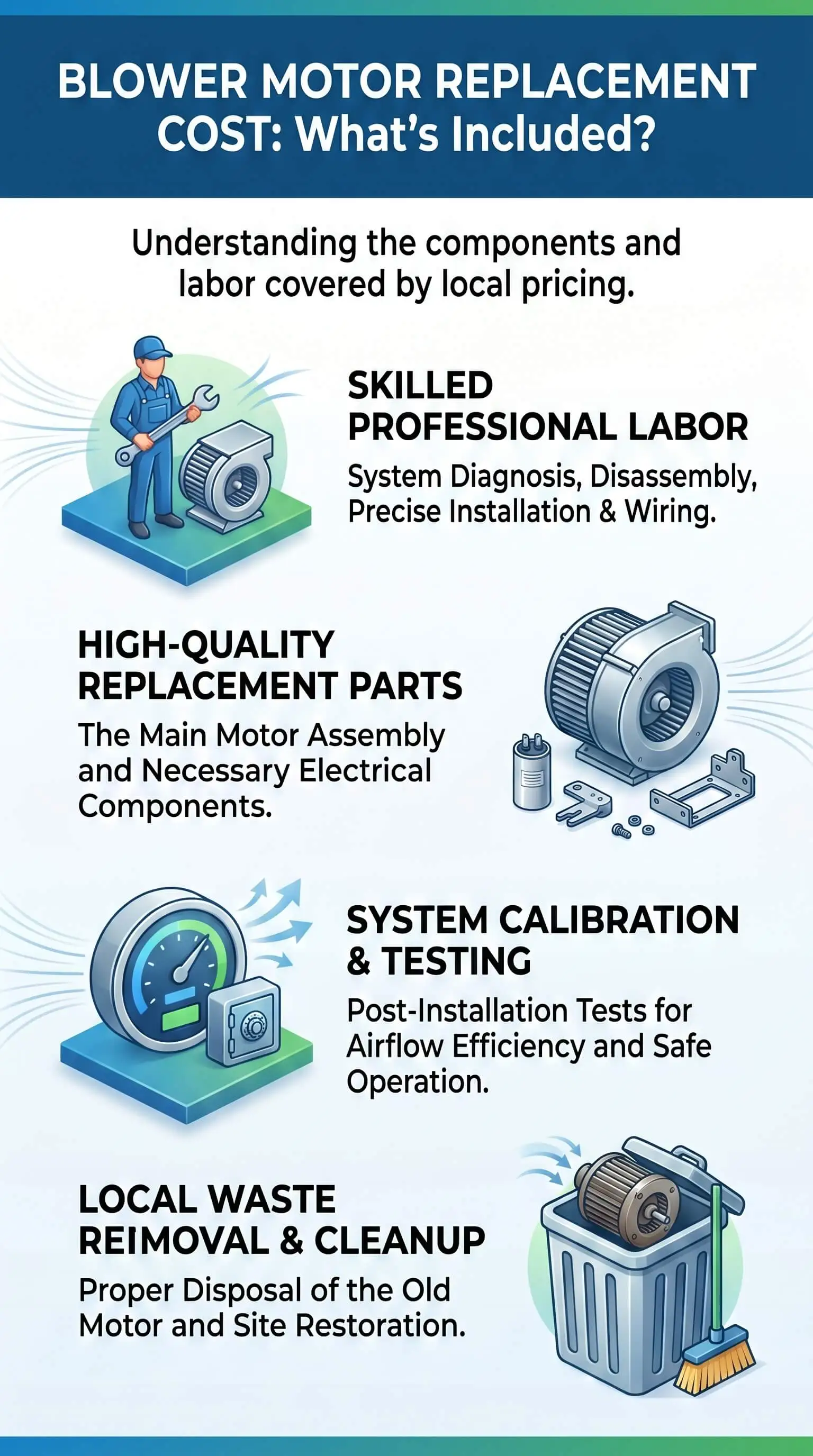
Labor covers diagnosis, safe install, and airflow testing, not only the part swap.
A weak capacitor can mimic a failed motor, and testing the capacitor first prevents repeat repairs.
Manufacturer parts warranties often cover the motor, but labor is usually a separate installer warranty.
Restricted airflow from a clogged filter is the most common contributor to early motor failure.
DIY is reasonable on a simple PSC swap. It's riskier on ECM systems with integrated control modules.
What "blower motor replacement" actually covers
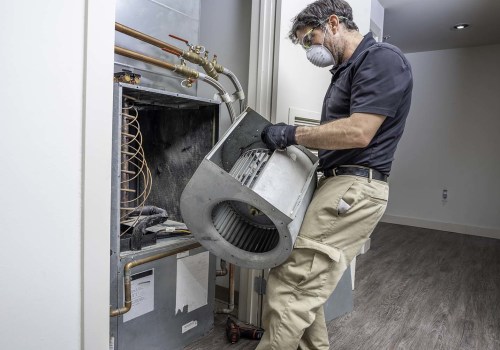
The blower motor sits inside the central-heating furnace and does the unglamorous job of pushing heated or cooled air through your ductwork. When it fails, the rest of the system can be working perfectly and you still won't feel a thing at the registers. A proper replacement covers more than swapping the part. The technician confirms the motor is actually the problem (and not the capacitor, control board, or thermostat), shuts down power safely, removes and installs the new motor, wires it correctly, and verifies airflow before driving away. Any quote that only pays for the part swap is leaving important work on the table.
Typical local price range
In our experience, most blower motor replacements land between $300 and $900 total once parts and labor are added together. We see jobs come in at the lower end when the motor is a single-speed PSC, the unit is easy to reach, and no extra parts are needed. The same job runs higher when an ECM motor is involved, the furnace lives in a tight attic closet, or the technician finds a damaged capacitor or burned wiring during the work. These numbers give you a planning range to set expectations. The only number that matters for your specific house is the one a technician hands you after looking at your system in person.
What raises the cost
Five things move the price more than anything else:
Motor type. ECM motors cost more than PSC motors, sometimes by several hundred dollars on the part alone.
Brand and OEM matching. Some systems require an original-equipment-manufacturer motor or a specific replacement kit to stay inside the warranty.
Access. Attic installs, tight mechanical closets, and packed utility rooms add labor time. In Central Florida especially, attic installs without a service platform can double the time on the clock.
Added parts. A worn run capacitor, a control module, mounting hardware, or wiring repairs each show up as separate line items.
Related damage. A clogged filter, dirty blower wheel, or overheated wiring extends the work.
When two quotes on the same furnace come in hundreds of dollars apart, the gap is almost always labor time, extra parts, or furnace filter-related airflow issues found during diagnosis. The motor itself rarely accounts for the difference.
Why PSC vs. ECM is the biggest cost lever after access
Two motor types show up in most residential furnaces, and the choice between them changes what you'll pay.
PSC (Permanent Split Capacitor) motors are the older, simpler design. They run at one or two fixed speeds and lean on a capacitor to start. Common in furnaces built before 2019, they're typically the less expensive replacement.
ECM (Electronically Commutated Motor) motors use built-in electronics to vary speed. They're standard in newer furnaces, hold steadier airflow, and pull noticeably less electricity over a season. The replacement part costs more, especially when the motor and control module are sold together as a single assembly.
A 2019 U.S. Department of Energy rule effectively required the brushless permanent magnet motors that ECM designs are built on, so most furnaces installed after that date use ECM technology by default. If you aren't sure what's in your system, ask the technician to identify it before any part gets ordered. We've watched homeowners pay for an ECM part on a system that turned out to use PSC because the original diagnosis skipped that check.
For a closer look at how PSC and ECM motor choices change the total cost of the repair, and how warranty coverage typically splits between parts and labor, a full cost-driver breakdown for furnace blower motors covers each variable in more detail.
Labor vs. parts: what you're actually paying for
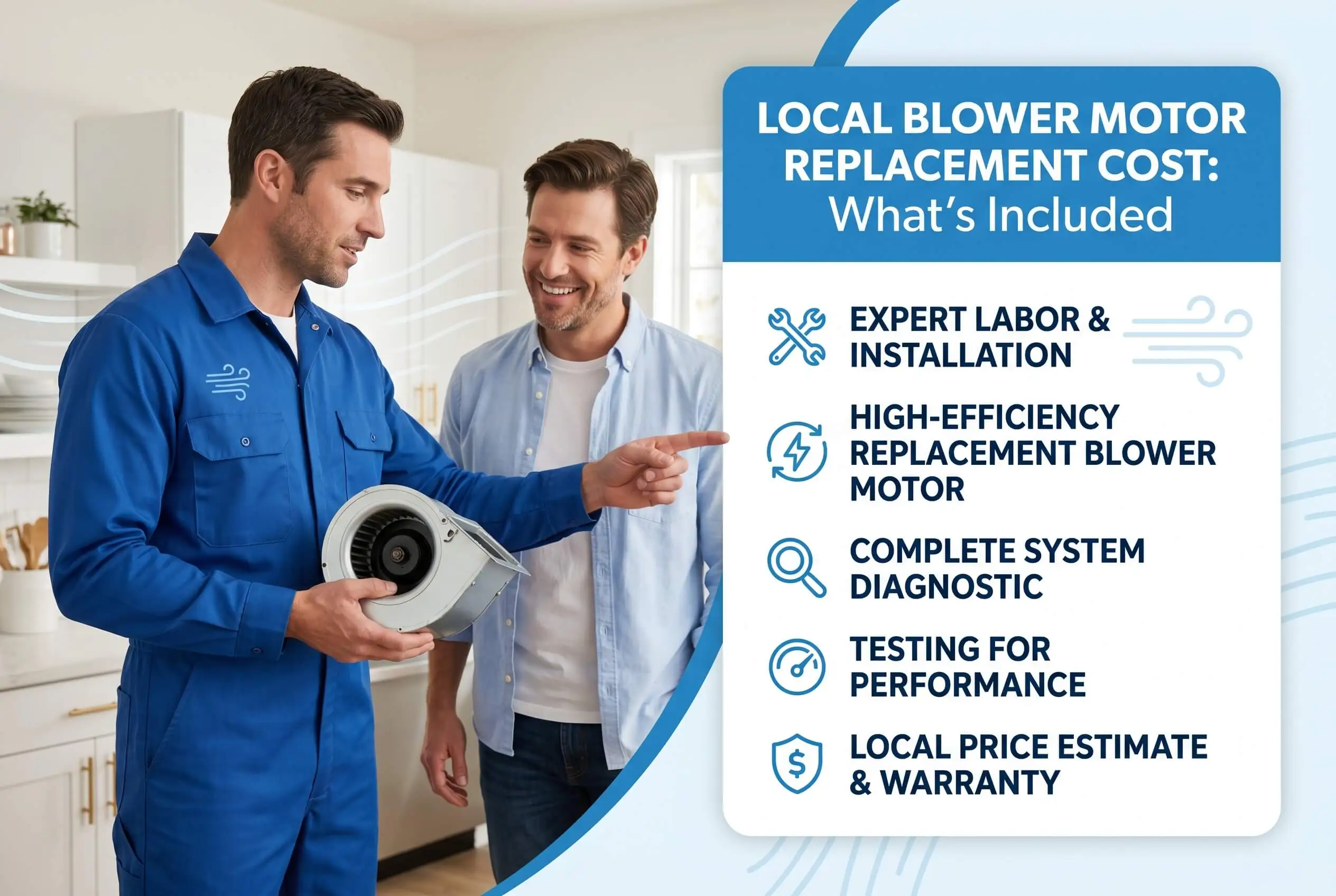
On a typical invoice, labor runs $150 to $400 and covers diagnosis, safe disassembly, motor installation, wiring, basic testing, and airflow verification. The part itself ranges from $50 to $450 for the motor alone, and ECM assemblies push higher than that.
The labor line covers more than hand-on-tool time. Most of it pays for the diagnosis that confirms the motor is the actual problem before anyone orders parts. A capacitor about to fail can imitate motor failure exactly. A board issue can shut a working motor down. Over the years, we've watched homeowners pay for two blower motor replacements on the same furnace within twelve months because the first job skipped the capacitor test.
Florida-specific considerations
A few patterns we see across Central Florida service calls:
Attic installs are common in pre-2005 housing here, and Central Florida attic temperatures run 130 to 140°F in summer. That kind of heat stresses motors, capacitors, and wiring continuously, every cooling season.
Subtropical humidity wears bearings and capacitor housings faster than drier climates do. Components that would last a decade up north often need attention sooner in our market.
Older flex-duct systems run higher static pressure. A motor pushing against restricted airflow works harder and dies earlier, which is the pattern we see in homes built before 2000 around Oviedo, Winter Park, and the older Maitland neighborhoods.
If your furnace sits in an attic and the original installer didn't bother adding a service platform, expect labor to run higher than the national average. That platform alone can save twenty to thirty minutes of awkward positioning work.
When to call a pro vs. when DIY can work
A handy homeowner with a simple single-speed PSC swap on an accessible unit can absolutely do this job. We've watched it go right plenty of times. We've also watched it go sideways: voided warranties, miswired motors that ran for an hour before burning out, and one case in Altamonte Springs where the homeowner replaced the motor without testing the capacitor first and lost the new motor to the same root cause inside a week.
There are three situations where calling a pro tends to pay for itself:
The system uses an ECM motor with an integrated control module.
The furnace runs on gas, where most manufacturer warranties require licensed installation.
The motor failed and nobody has identified a clear root cause yet.
For everything else, the deciding factor is whether you can confirm the diagnosis before ordering parts. If you can, DIY is on the table and may help extend the lifespan of HVAC system components by addressing the right issue first. If you can't, the labor charge buys you the diagnosis you need anyway.
"The expensive mistake on these calls almost never has anything to do with picking the wrong contractor. The real damage happens when a homeowner approves the replacement before anyone tests the capacitor. On a PSC system, a weak capacitor can imitate a failed motor down to the symptom, and a fresh motor wired to a bad capacitor often burns out inside 60 days. A five-minute test before parts get ordered protects the whole repair, and it's the first thing I check on every weak-airflow call I've run in this area for nearly two decades."
Essential Resources
Seven primary-source references worth bookmarking before you sit down with a quote:
U.S. Department of Energy — Residential Furnace Fans Rulemaking. The official record on the 2019 efficiency standards that effectively required ECM-class motors in new furnace fans.
Lawrence Berkeley National Laboratory — Residential Furnace Blower Performance. Peer-reviewed measurement data on real-world blower power consumption and motor efficiency in U.S. homes.
Appliance Standards Awareness Project — Furnace Fans. Plain-language summary of the DOE standards and what they mean for replacement motor selection.
ENERGY STAR — Furnaces Program. Federal efficiency thresholds, regional standards, and consumer rebate guidance for furnace purchases.
ENERGY STAR — Furnaces Key Product Criteria. Technical definitions for AFUE, air leakage, and the metrics that govern federal furnace certification.
Florida Department of Business and Professional Regulation — License Verification. Official source for verifying that a Florida HVAC contractor holds an active Certified Air Conditioning Contractor (CAC) license before approving work.
U.S. Department of Energy — Energy Saver: Heat & Cool. Consumer-facing federal guidance on residential heating and cooling efficiency, maintenance, and upgrade considerations.
Supporting Statistics
Three federal- and laboratory-grade data points that frame what a blower motor actually does and why efficiency standards changed:
1. The 2019 furnace fan rule projected to save $9 billion in homeowner electricity bills
The U.S. Department of Energy's furnace fan efficiency standards, effective July 2019, are projected to save approximately 3.99 quadrillion BTUs of energy and over $9 billion in home electricity bills through 2030. U.S. Department of Energy.
This is the rule that pushed manufacturers from PSC to ECM-class motors in new furnaces. It's the reason your replacement options now skew toward higher-efficiency designs, and it's why the part you're being quoted today probably costs more than the same repair would have cost a homeowner ten years ago.
2. ECM-class motors reduce blower electricity consumption by approximately 50%
For most furnace fans, current federal standards effectively require brushless permanent magnet (BPM) motors, which reduce electricity consumption by about 50% compared with conventional PSC motors. Appliance Standards Awareness Project.
The trade-off in plain terms: an ECM motor costs more upfront, but the energy delta over a 15- to 20-year service life often outpaces the price gap on the part itself. Customers tell us their summer electricity bills drop noticeably after an upgrade, though the actual savings vary plenty by home and climate.
3. Furnace blowers represent 20–25% of high-efficiency AC system power draw
Typical residential furnace blower power consumption runs 500 to 700 watts, representing 20 to 25% of the power consumed by a high-efficiency air conditioner. Lawrence Berkeley National Laboratory.
The blower runs during both heating and cooling cycles, so motor efficiency hits your electric bill year-round, not only in winter. Up here in Florida, where the cooling season runs nine or ten months, that year-round factor matters more than the LBNL national figures suggest.
Final Thoughts and Opinion
After years of these calls, here's the pattern we keep coming back to: the most expensive part of a blower motor job rarely lives in the motor or the labor lines. The real cost shows up later, when work gets approved before the diagnosis is solid. A top furnace filter helps keep airflow cleaner and more consistent, which can make it easier to spot whether the problem is truly the motor, the wiring, or restricted airflow. The repairs that come back to us a year out, the second motor, the burned wiring, the homeowner who replaced everything and still has weak airflow, almost always trace to a quote signed off before someone confirmed the actual failure point, including whether a top furnace filter was supporting proper airflow.
Four questions change the odds. Get the diagnosis first. Then confirm the motor type before parts are ordered. Ask whether the capacitor is being replaced on a PSC system. And ask what the warranty actually covers, parts only or parts plus labor. None of these add time to the visit. All of them meaningfully change how long the repair holds.
Keep the filter clean while you're at it. A blower motor working against a clogged filter is a motor wearing out early, every cooling season.
Frequently Asked Questions
How much does a blower motor replacement usually cost?
Most replacements fall between $300 and $900 total, including parts and labor. Simple PSC motor swaps on easy-to-reach units land at the lower end of that range. The upper end shows up when you've got an ECM replacement with an integrated control module, an attic install, or extra parts like a capacitor in play. Whatever number a technician gives you after an on-site diagnosis is the only one that actually matters for your house.
Is it cheaper to repair the blower motor or replace the whole furnace?
For a furnace under 12 years old that's otherwise running well, replacing the motor almost always makes more sense. On a furnace 15+ years old with other issues already present, putting $700 into a motor on a system that may need a heat exchanger or control board within the next two years is harder to justify. A technician should give you both numbers and let you make the call.
How long does a blower motor typically last?
Most blower motors last 10 to 20 years. The variables that shorten that life are restricted airflow from clogged filters or closed registers, heat exposure (attic installs in Central Florida regularly see 130 to 140°F summer temperatures), and electrical issues like a weak capacitor running the motor outside its design parameters. Clean filters and proper ductwork double the difference.
Can a dirty filter actually kill a blower motor?
Yes. A clogged filter restricts airflow, which forces the motor to work harder against higher static pressure. The motor draws more current, runs hotter, and the bearings and windings wear faster. We've pulled motors that failed at year six on furnaces where the filter had clearly gone uncleaned for years. A $20 filter changed on schedule protects a $400 motor.
Should I get more than one quote?
For anything over $500, yes. The same job can quote $400 to $1,200 across three contractors depending on motor type, access, and what extras get included. Asking each contractor to itemize parts, labor, and any extra components (capacitor, control module, wiring) makes the comparison meaningful. A higher quote isn't always a worse one if it includes work the cheaper quote skipped.
Will my warranty cover the motor and the labor?
In most cases, the part is covered and the labor is not. Manufacturer parts warranties commonly cover defective motors within the coverage window. Labor is almost always handled separately, through the original installer's labor warranty or an extended labor plan. Before approving any work, ask whether the motor is covered, whether labor is included, and whether you need proof of maintenance to use the warranty.
How do I know the motor is the actual problem?
The technician's diagnosis should rule out the capacitor, the control board, the thermostat, and the limit switch before the motor gets blamed. On a PSC system, a capacitor test takes five minutes. On an ECM system, a control module fault can shut down a working motor. If a technician quotes a motor replacement without explaining why the motor itself is the confirmed problem, ask for the diagnostic results before you sign off.
Compare Your Quote Before You Approve It
The honest number for your house lives in an on-site diagnosis, not a national average. Compare your quote against the cost framework above before signing off, and ask the questions that separate a basic part swap from a reliable HVAC upgrade that actually solves the airflow problem and supports better system performance long term.
For homeowners comparing Blower Motor Replacement Cost Near Me: What Local Prices Include, the biggest lesson is that airflow problems can make a simple motor quote look more complicated than it really is. A clean, correctly sized filter helps reduce strain on the system before weak airflow turns into a bigger repair conversation, which is why options like 16x20x1 air filters, 17x22x1 furnace filters, and 24x24x5 HVAC filters fit naturally into the discussion. They reinforce the same point the article makes: local blower motor replacement cost is not just about the motor itself, but also about the condition of the surrounding airflow path, the filter setup, and the maintenance choices that help keep the blower from working harder than it should.