I check the Central Ohio forecast most summer mornings, and an orange reading is what makes me rethink the afternoon. Some of the changes happen outdoors. The ones people forget happen inside the house.
TL;DR Quick Answers
air quality Columbus Ohio
Air quality in Columbus Ohio is good or moderate on most days. On several days each year, summer ozone and fine-particle spikes push the AQI into the orange 101 to 150 range, and MORPC issues an Air Quality Alert. The metro earned an F for short-term particle pollution in 2026, so indoor air deserves equal attention.
Today’s reading: AirNow posts the official Columbus AQI and forecast, and MORPC adds local alerts.
Summer driver: Ozone runs March through October and peaks on hot, sunny, still afternoons.
Year-round driver: Fine particles, including wildfire smoke, can spike in any season, often overnight.
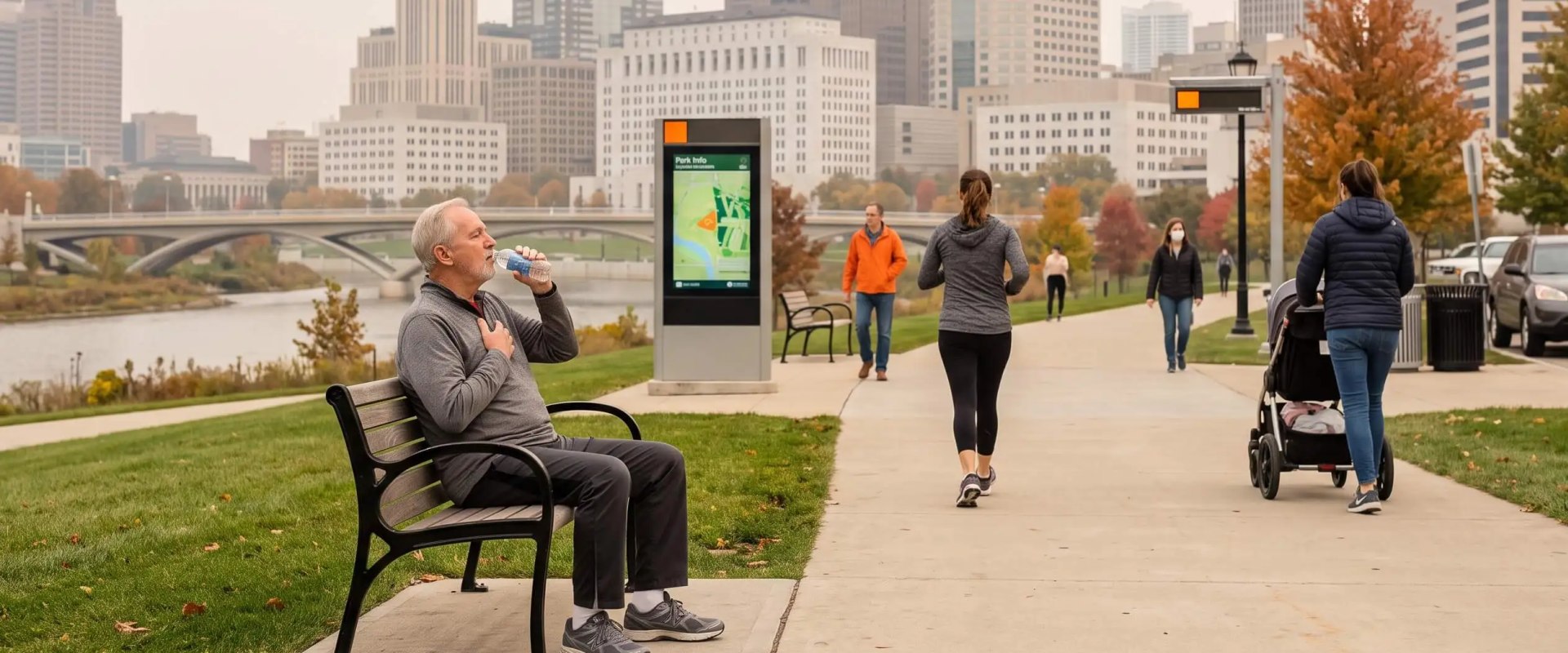
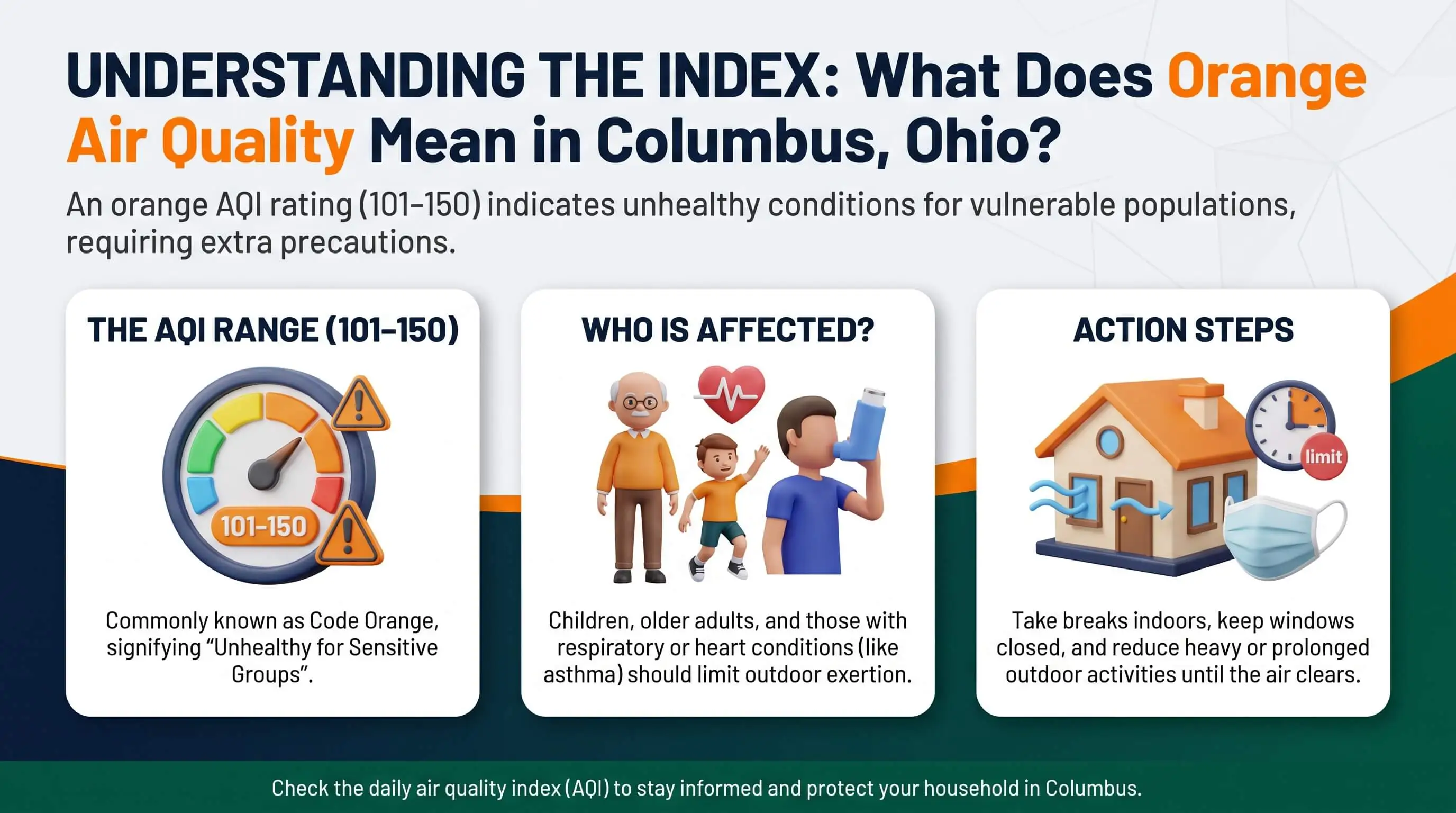
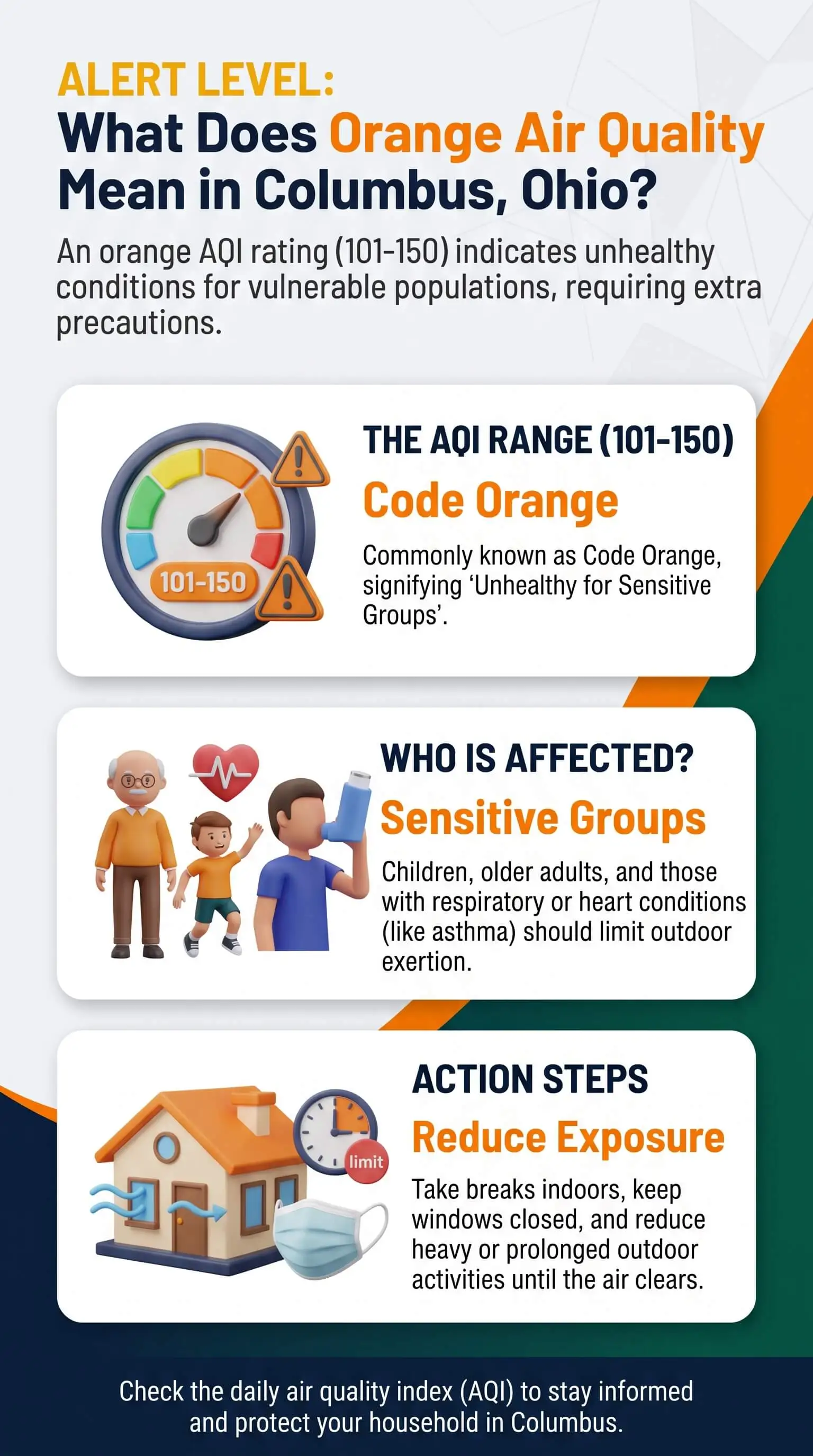
On orange days: Children, older adults, outdoor workers, and anyone with asthma, COPD, or heart disease should cut back on long or hard outdoor activity.
Indoors: Close the windows on alert days, switch the thermostat fan from Auto to On, and run the highest MERV filter your system can handle.
Alerts: MORPC sends free email alerts the evening before a forecast alert day.
Top Takeaways
Orange means an AQI of 101 to 150. That's the Unhealthy for Sensitive Groups band, and MORPC issues an Air Quality Alert at this level.
Sensitive groups should ease off. Children, older adults, outdoor workers, and anyone with lung or heart disease fall into this group.
Ozone drives the summer alerts. It peaks on hot, sunny afternoons between March and October.
Particles are the bigger Columbus problem. The metro earned an F for short-term particle pollution in 2026.
Your indoor air needs attention too. Close the windows, set the fan to On, and run the best filter your system supports.
What Orange Means on the Air Quality Index
The Air Quality Index scores outdoor air from 0 to 500 and sorts it into six color bands. A score of 100 roughly matches the federal health standard for each pollutant, which makes orange the first band where the air turns unhealthy for anyone at all.
Green (0 to 50): Good air for everyone.
Yellow (51 to 100): Fine for most people, though a few unusually sensitive people may notice it.
Orange (101 to 150): Sensitive groups may feel effects, and the general public probably won't.
Red (151 to 200): Some healthy people start feeling it, and sensitive groups feel it more.
Purple and Maroon (201 and up): Health alerts and emergency conditions for everyone.
Around here, orange also sets off an Air Quality Alert. The Mid-Ohio Regional Planning Commission, better known as MORPC, issues one whenever it forecasts pollution at 101 or higher for Franklin, Delaware, Fairfield, and Licking counties.
Why Columbus Has Orange Air Quality Days
Summer Ozone, March Through October
Tailpipes don't release ozone directly. It forms when exhaust from cars, trucks, and gas-powered lawn equipment reacts in hot sunlight, so MORPC forecasts it only from March through October. Hot, bright, windless afternoons are the worst. That's why most Columbus alerts land in July and August.
Fine Particles and Wildfire Smoke
Fine particle pollution, or PM2.5, never gets a season off, and MORPC tracks it all year. Diesel traffic and wood-burning fireplaces push it up. So do cool nights, when a layer of cold air traps pollution near the ground until morning sun breaks it apart. Smoke from distant wildfires adds to the load, and in mid-July 2026, Central Ohio saw back-to-back alerts as Canadian smoke piled on top of summer ozone.
How Columbus Compares
The American Lung Association's 2026 State of the Air report gave the Columbus metro an F for short-term particle pollution and ranked it 34th worst in the nation. Ozone fared better, at 110th worst. So while smog grabs the summer headlines, particle spikes are the bigger problem here.
Who Should Worry on an Orange Air Quality Day
Children: Their lungs are still growing, and they spend more time running around outside than the rest of us.
Older adults: Age leaves less reserve in the heart and lungs.
People with lung disease: Asthma, COPD, chronic bronchitis, and emphysema all leave airways quicker to react.
People with heart disease: The CDC links particle pollution to heart attacks and strokes in this group.
Outdoor workers and athletes: They breathe harder and longer, often straight through the worst hours of the day.
Know the warning signs. Watch for coughing, a scratchy throat, chest tightness, pain on a deep breath, or shortness of breath. If you have heart disease and notice palpitations or unusual fatigue, call your health care provider.
Here's something that might surprise you: some perfectly healthy people are simply more sensitive to ozone. When an easy run feels harder than it should on an orange afternoon, believe your lungs.
Outdoor Precautions That Keep Your Plans Intact
You rarely need to cancel anything on an orange day. Changing the time, the place, or how hard you push usually does the job.
Go earlier on ozone days. Ozone builds as the afternoon heats up, so morning practices, runs, and yard work get the cleanest air.
Dial down the effort. Walk instead of run, take more breaks, and wrap up sooner.
Keep the rescue inhaler close. Follow your asthma action plan, and keep the inhaler in your bag rather than the glove box.
Help keep ozone down. Refuel after dusk, skip idling, and hold off on gas mowing until the alert ends.
Indoor Precautions Most People Skip
Don't take your indoor air for granted on an orange day! Fine particles drift in through open windows, gaps around doors, and fresh-air intakes, and you'll never see them arrive. Here's exactly what to do about it:
Close the windows during afternoon ozone peaks and any time smoke shows up in the forecast.
Switch the thermostat fan from Auto to On so air keeps moving through your filter between heating and cooling cycles.
Check the MERV rating printed on your filter frame. A MERV rating chart shows how each level handles fine particles, and on smoke days, MERV 13 earns its spot if your system can handle the airflow.
Close any fresh-air intake on smoke days so your system recirculates the air already inside.
Swap out a loaded filter. Once it turns gray and dusty, it chokes airflow and catches less.
Pro Tip: A filter only cleans the air your system pushes through it. Upgrade the filter but leave the fan on Auto, and that new filter sits idle every time the system shuts off.
How to Check Columbus Air Quality Before You Head Out
Pull up the official reading and forecast on AirNow before you lock in plans.
Look at which pollutant is leading. Ozone points to an afternoon problem, while PM2.5 can hang around all day.
Sign up for MORPC's free email alerts, which land the evening before a forecast alert day.
Check again midafternoon in summer, since ozone can climb fast after lunch.
“In my years treating Central Ohio patients with asthma, I've watched ozone flare-ups show up in the evening, hours after the time spent outside, because ozone inflames the airway lining much like a sunburn and that swelling keeps building. On an orange day, I ask families to move outdoor play before noon and to keep the rescue inhaler within reach that night, not just during the game.”
7 Essential Resources
Columbus Live Air Quality Map: Today's Columbus AQI, the pollutant leading it, and indoor filtration steps matched to each color band.
AirNow: AQI Basics: The official six-color scale, with what each category means for your health.
MORPC: Air Quality Alerts and Forecasts: Central Ohio alerts, the email sign-up, and who's most at risk from ozone and particles.
EPA: Health Effects of Ozone Pollution: The people ozone affects most and the symptoms worth watching.
CDC: About Air Quality: Practical ways to shift the time, place, or intensity of activities on Code Orange days.
NIEHS: Air Pollution and Your Health: Federal research on what air pollution does inside the body.
American Thoracic Society: Asthma and Air Pollution: How ozone and fine particles affect the airways of people with asthma.
3 Supporting Statisticshe Columbus-Marion-Zanesville metro ranked 34th worst in the nation for short-term particle pollution in the 2026 State of the Air report and earned an F. American Lung Association 2026 Ohio Report
The Ohio EPA ran 113 monitoring sites reporting data from 45 counties in 2024, and 50 of those sites tracked ozone continuously. Ohio EPA: Ohio Air Quality 2024
The Asthma and Allergy Foundation of America treats an AQI of 101 or higher as unhealthy for people with asthma and advises limiting time outdoors from 11 a.m. to 8 p.m. when pollution runs high. AAFA: Air Pollution, Smog, and Asthma
Final Thoughts and Opinion
I'll say it plainly. An orange reading shouldn't shut down your day, and for most Columbus families it simply means moving soccer practice to the morning. Where I see people slip is after they come back inside. The windows are open. The fan's on Auto, and nobody has pulled the filter since spring. That's the part you control, and fixing it takes about five minutes, so close up the house, flip the fan to On, and give the filter a look. Dryer vent cleaning is another important part of home maintenance that helps prevent lint buildup and keeps your ventilation system working properly. It takes little effort for a big impact, and it's how you become the hero of your household on a bad air day.
Frequently Asked Questions
Is Orange Air Quality Bad for Healthy Adults?
Usually not. Most healthy adults won't notice anything between 101 and 150. If you start coughing or feel chest tightness while exercising, ease up.
Can Kids Play Outside When the Air Quality Is Orange?
Yes, with a few adjustments. Schedule play for the morning on ozone days, build in breaks, and keep any child with asthma close to their inhaler.
Is Orange Air Quality Worse in the Morning or Afternoon?
Ozone peaks in the afternoon. Particle pollution behaves differently and can climb overnight and into the early morning, when cool air holds it near the ground.
What Is the Difference Between Orange and Red Air Quality?
Orange, at 101 to 150, mainly affects sensitive groups. Red, at 151 to 200, means some healthy people may feel effects as well, so everyone should cut back on heavy exertion.
How Do I Get Air Quality Alerts in Columbus?
Sign up for MORPC's free email alerts, which arrive the evening before a forecast alert day. The AirNow app shows current readings and forecasts too.
Should I Run My Air Conditioner During an Orange Alert?
Yes. Keep the windows shut, let your furnace or AC system run, and set the fan to On so your filter keeps cleaning the air inside.
Know What Orange Means Before You Plan Your Day
Orange air quality in Columbus, Ohio asks sensitive groups to scale back and every household to keep its indoor air clean. Check the morning forecast, move outdoor plans earlier, and let your HVAC system and a good filter handle the rest.