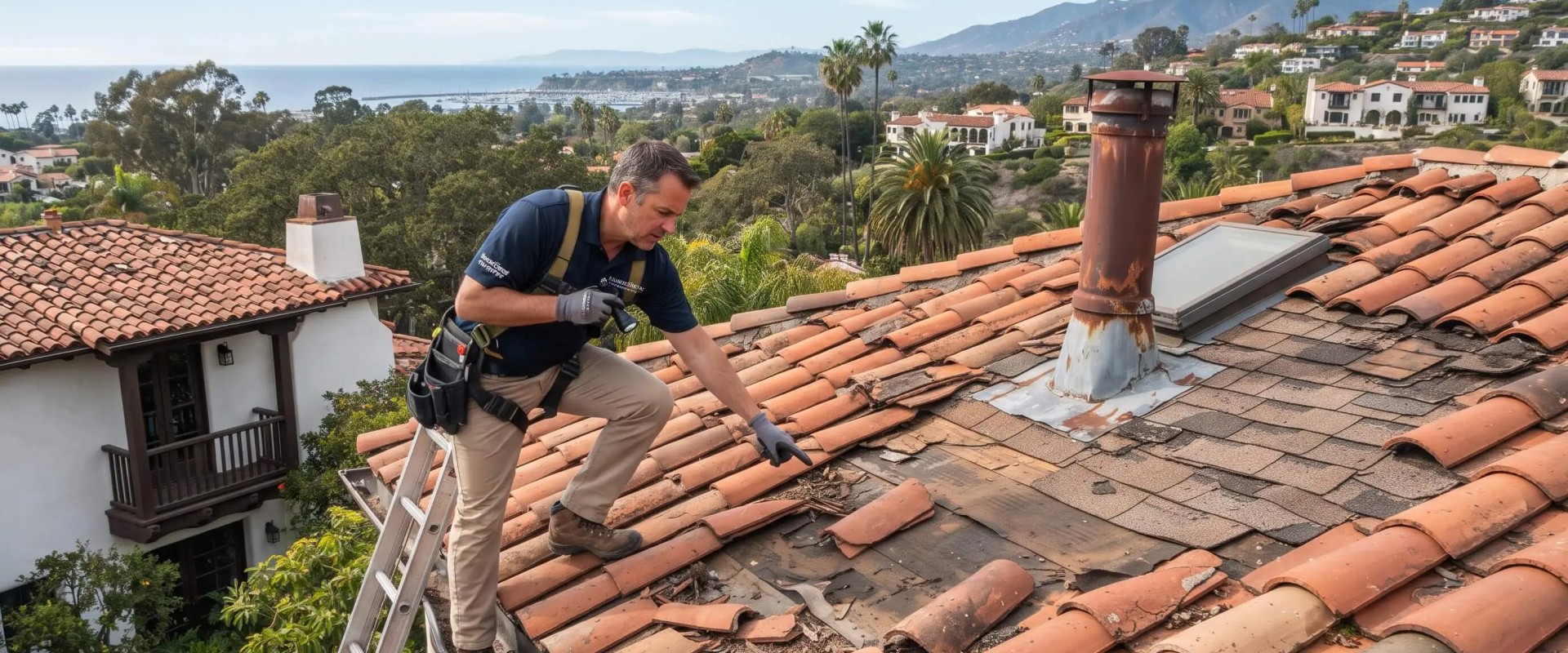
One line turns up in Santa Barbara inspection reports again and again, and it worries buyers far more than it should. It usually reads something like "roof covering showing signs of age, recommend further evaluation by a licensed roofing contractor." When we follow up on it, we usually find worn underlayment under tile that still looks good, along with some mix of cracked or slipped tiles, tired flashing, dried-out sealant around vents and drains that hold water.
Nearly all of that is repairable. We've worked on more than 10,000 roofs across Santa Barbara County since 1996, and the question we help buyers answer in escrow is which findings change the price and which ones belong on a maintenance list. A roof inspection in Santa Barbara answers it with photos and plain language instead of one vague sentence in somebody else's report.
TL;DR Quick Answers
Roof Inspection Santa Barbara
Santa Barbara inspections most often find worn underlayment, cracked or slipped tile, aging flashing, failed sealants and poor drainage, and most of it is repairable.
Tile can outlast its underlayment by decades, so a clean-looking roof can still need work underneath.
General home inspectors view the roof from the ground or eaves and often recommend further evaluation.
Separate fix-now items from budget-for and monitor items before you negotiate.
Most roof inspections take 60 to 90 minutes, with the report in 2 to 3 business days, so book early in escrow.
Photos and a repair estimate give you a clear basis for credits or repair requests.
Top Takeaways
Santa Barbara inspections most often turn up worn underlayment under tile, cracked or slipped tiles, aging flashing, failed sealants and poor drainage.
Clay tile can last 100+ years, but InterNACHI rates the felt underlayment under it at 15 to 30 years, so a tile roof can look fine and still need work.
A general home inspector views the roof from the ground or eaves, while a roofer checks what's underneath wherever it's accessible.
Sort every finding into fix now, budget for or monitor, and you'll see that most are repairable and few are deal breakers.
Book the roof inspection early in your contingency period so the photos and repair estimate arrive before you negotiate.
The Short Answer: Roof Problems Santa Barbara Inspections Flag Most
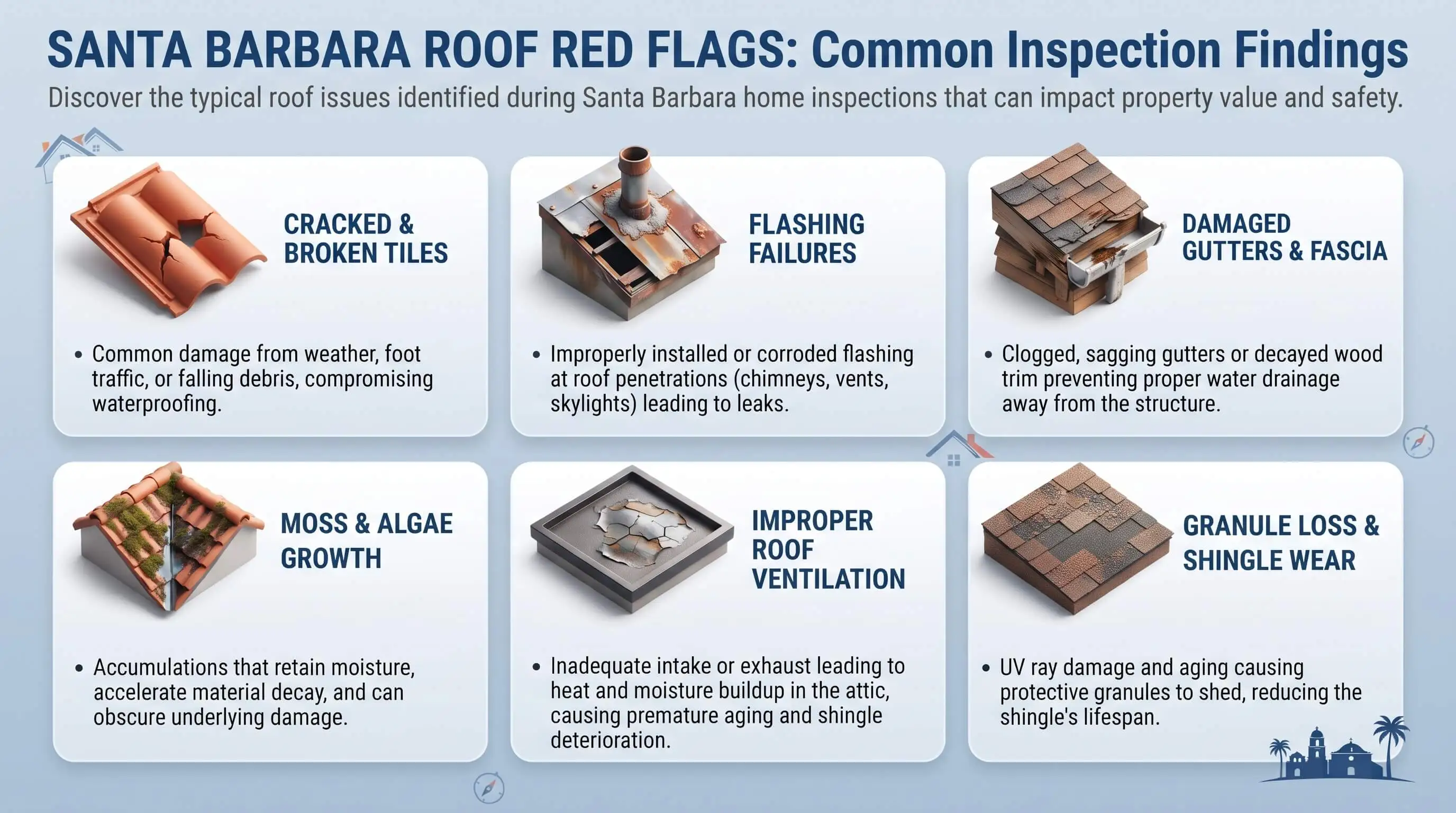
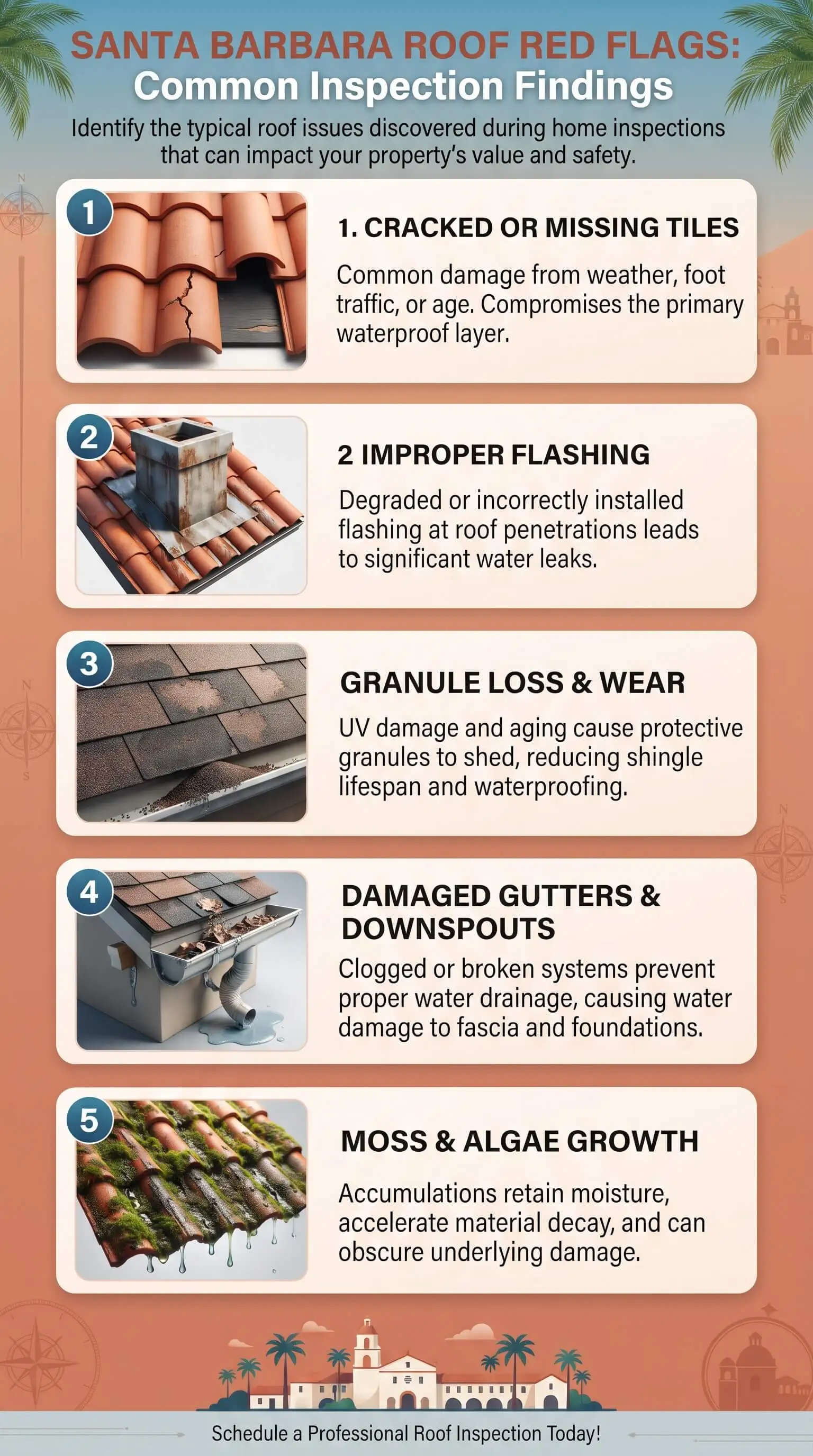
Worn underlayment beneath tile, cracked or slipped tiles, aging flashing, failed sealants around roof penetrations and poor drainage show up most often in Santa Barbara home inspections. Most of them are isolated and fixable. A few, like underlayment that's given out across the whole roof or decking that's gone soft, can change what a house is worth.
Here's roughly how often we see each one, most common first.
Worn underlayment beneath tile that still looks fine
Cracked, slipped or broken clay and concrete tiles
Aging or corroded flashing at walls, chimneys and skylights
Failed sealants and pipe boots around vents and other penetrations
Ponding water and worn seams on flat and low-slope roofs
Clogged valleys, gutters and scuppers
Evidence of past leaks in the attic
Previous repairs that are starting to fail
Missing shingles and granule loss on asphalt roofs
Why Santa Barbara Roofs Show Different Problems
Our weather is easy on people and quietly hard on roofs. Most of the damage we document traces back to a handful of local conditions working on each other.
Long dry stretches hide defects. A cracked tile or lifted piece of flashing can go months without rain to expose it, which is why summer inspections so often turn up problems the owners never knew about.
Storms arrive in bursts. When the rain finally comes, it tends to come hard, and every weak seam gets tested at once.
Clay tile looks better than it is. Tile sheds most of the water, but the underlayment below does the real waterproofing, and tile can outlast that layer by decades.
Salt air works on metal. Closer to the coast, flashing, vents and fasteners corrode faster.
Foothill homes catch more wind. Up in the foothills and Montecito, tiles loosen and edges lift more often than they do on the flats.
A lot of the housing is older. Original roofs and layers of patchwork are common here, and every layer is one more thing to check.
The Most Common Roof Problems, Ranked
Worn Underlayment Beneath Tile That Still Looks Fine
Buyers misread this one more than any other. The tile looks clean from the street, but the felt or synthetic layer under it has dried out, cracked or torn at the ends.
A general home inspector usually can't see it without lifting tile, so the report just mentions age. When we lift a few tiles at the eaves and valleys and the underlayment crumbles, the fix is often a tile lift and re-lay rather than a new roof. Good tile can usually go right back on.
Cracked, Slipped or Broken Clay and Concrete Tiles
This is the most visible finding on Santa Barbara roofs. Past contractors walking the roof, wind and ordinary settling all crack and shift tile.
A few broken pieces is routine work. We check what's underneath next, because a gap that lets water reach the underlayment for several winters can turn a small fix into a section repair.
Aging or Corroded Flashing at Walls, Chimneys and Skylights
Flashing seals the joints where the roof meets a wall, chimney or skylight, and it's behind a lot of the leaks we trace.
Near the coast, we often find rust, lifted edges, or old mortar and sealant standing in for flashing that should be there. These spots are usually repairable on their own. They just need a roofer's eye, since the failure tends to hide under tile or siding.
Failed Sealants and Pipe Boots Around Roof Penetrations
Every vent pipe, skylight and roof-mounted fixture is a hole in the roof, and the rubber boots and sealant around them break down in the sun.
These are some of the quickest, least expensive fixes on any report. They're also one of the most common reasons a roof that looks fine still leaks.
Ponding Water and Worn Seams on Flat and Low-Slope Roofs
Plenty of additions, garages and mid-century homes here have flat or low-slope sections. Water still sitting a day or two after rain is what we flag.
We look hard at seams, drains, scuppers and the perimeter. Ponding doesn't mean the roof has failed, but it shortens the membrane's life and usually points to drainage worth correcting.
Clogged Valleys, Gutters and Scuppers
Leaves and needles pile up in valleys and drains, especially under oaks and sycamores. When water can't get off the roof, it finds another way in.
This is nearly always maintenance, not repair. Clearing it before the rains start heads off a good share of the leak calls we get each winter.
Evidence of Past Leaks in the Attic
Stained rafters, flattened insulation and soft spots in the deck tell you the roof's history. They don't always mean it's leaking now.
We check whether the stain is dry, whether anyone fixed the source and whether the decking above is still sound. If it is active, it's worth knowing how long a roof leak can safely wait before it does more damage.
Previous Repairs That Are Starting to Fail
Older roofs here often carry years of patches. Some were done well. Others were tar spread over a problem nobody traced.
We photograph past repairs and note which ones are holding up and which aren't. When several patches are failing in one area, it usually means nobody fixed the cause.
Missing Shingles and Granule Loss on Asphalt Roofs
You'll see more asphalt shingle roofs in Goleta and on newer tract homes. Missing tabs after a windstorm and granules collecting in the gutters are the usual signs of age.
Scattered damage is a straightforward repair. Widespread granule loss, curling or brittle shingles tell us the roof is close to the end of its service life, and you'll want to know that before you close.
Home Inspection vs. Roof Inspection in Santa Barbara: What Each One Catches
A general home inspection covers the whole house, and the roof is one line on a long list. A roof inspection spends the entire visit on that one system.
General home inspection:
Scope covers visible roof covering, flashing, gutters and penetrations
Inspectors often view the roof from the ground, a ladder or a drone, especially when it's tile
Inspectors rarely evaluate underlayment and decking directly
Photos vary by inspector
Roof concerns usually end with "further evaluation recommended"
It's part of a home inspection that covers every system in the house
Roof inspection by a roofing contractor:
Scope covers roof surfaces, flashing, valleys, penetrations, drainage, accessible prior repairs and visible signs of moisture
A roofer who knows how to move on tile without breaking it does the inspection
We check underlayment and decking wherever we can reach them, including from the attic side
We photograph each concern in the report
You get repair and maintenance priorities, plus a separate repair estimate if you ask for one
Most residential roofs take 60 to 90 minutes, and the report arrives in 2 to 3 business days
If the home inspector flags the roof, or the roof is tile and older than about 20 years, we'd book a dedicated roof inspection in Santa Barbara early in your contingency period. You'll have photos and a repair estimate in hand before you have to decide anything.
Fix Now, Budget For or Monitor: How Serious Is Each Finding?
Not every finding means the roof needs to be replaced. We sort what we find into groups so buyers and sellers know where they stand.
Fix now. Active leaks, soft decking, missing flashing and open gaps over failed underlayment belong here. Get them repaired before the rainy season, and expect them to come up in escrow negotiations.
Budget for. Underlayment near the end of its life, widespread granule loss, ponding on a flat roof and a run of failing prior repairs mean larger work in the next few years. These often lead to a credit or a price conversation.
Monitor. A few cracked tiles, debris in the valleys, aging sealant and old dry stains with a confirmed repair are routine maintenance, and they're rarely a deal breaker.
How to Use Roof Findings During Escrow
A roof report helps most when it shows up early enough to act on.
Order it early. Book the roof inspection in the first days of your contingency window and tell us your deadline so we can talk about expedited reporting.
Ask for photos. Pictures of each concern make it far easier for agents, sellers and lenders to see what we found.
Separate repairs from upgrades. Use the fix-now items for repair requests or credits, and keep the budget-for items in the price conversation.
Keep the report. It records the roof's condition the day you bought it, which helps later with insurance and maintenance planning.
Allison M. said it well in her review: "The inspection report had photos of every issue and a clear plan. We used it to negotiate credits during our home purchase."
Sellers can flip the same approach. An inspection before listing lets you fix the small items, disclose the rest and avoid surprises halfway through escrow.
When Roof Problems Reach the Attic, Ducts and Indoor Air
In a lot of Santa Barbara homes the ductwork runs through the attic, and sometimes the furnace or air handler sits up there too. A roof problem above that equipment quickly becomes a whole-house problem.
Wet insulation makes heating and cooling work harder, and water dripping onto ducts ruins their insulation wrap. A damp attic also gives mold somewhere to grow. If you catch a musty smell when the system kicks on, read up on how moisture and mold in your HVAC system affect the air you breathe, and have the roof above it checked.
"The roof buyers misread most is a tile roof that looks perfect. They see clean red tile from the driveway, then the report says 'further evaluation recommended,' and nobody's sure what that means. Most of the time the answer is right under the first few tiles we lift at the eaves and in the valleys. Sometimes the underlayment is still flexible and has years left in it. Sometimes it comes apart in our hands. From the street, those two roofs look exactly the same, and in escrow that difference can matter more than anything else the buyer learns about the house. We also read plenty of reports that sound worse than the roof really is. A few cracked tiles and some dried-out sealant around a vent is maintenance, and it's no reason to walk away from a house you love. What we try to give people is a clear line between what needs attention now and what can wait. Thirty years on Santa Barbara roofs has taught us that what's underneath matters most."
Essential Resources
The buyers and sellers who get the most out of a roof report know what it can and can't tell them. These are the sources we'd hand anyone heading into escrow on a Santa Barbara home.
1. See Exactly What a General Home Inspector Checks on the Roof
InterNACHI's Standards of Practice say a home inspector looks at the roof from the ground or the eaves and isn't required to walk on it. That's why so many reports end with "further evaluation recommended," especially on tile. Read the roof section before your inspection so you know what the report will cover.
Home Inspection Standards of Practice from InterNACHI
2. Check the License of Anyone Who Inspects or Repairs Your Roof
The CSLB lookup takes about two minutes and shows license status, classification, bonding and any complaint history. Ours is CSLB #504492. Look it up, along with anyone else whose name shows up on your roof report.
Check a Contractor License from the California Contractors State License Board
3. Know What the Seller Has to Tell You About the Roof
California sellers fill out a Real Estate Transfer Disclosure Statement that asks for the roof's type, its approximate age and any defects they know about. The Department of Real Estate's booklet walks through the form and explains your rights if a disclosure shows up late. Hold the seller's answers up against what the inspection finds.
Disclosures in Real Property Transactions from the California Department of Real Estate
4. Find Out Whether Past Roof Work Was Permitted
The City of Santa Barbara issues instant permits for reroofs that keep the same material and express permits when the material changes. If a seller says the roof is newer, ask to see the permit. An unpermitted reroof is something you want to know about before closing, not after.
Building Permit Forms and Applications from the City of Santa Barbara
5. Look Up the Home's Fire Hazard Severity Zone
Plenty of homes in the foothills, Montecito and the Santa Ynez Valley sit inside mapped fire hazard zones, where roof materials and upkeep carry extra weight. Type an address into CAL FIRE's viewer and it shows you the zone. Check it before you plan any reroofing.
Fire Hazard Severity Zones from the CAL FIRE Office of the State Fire Marshal
6. Understand What Homeowners Insurance Won't Cover
The California Department of Insurance's homeowners guide lists wear and tear, maintenance and seepage leaks among the perils policies usually exclude. In practice, roof problems found during an inspection generally become the new owner's bill once escrow closes. Read it before you decide what to negotiate.
Residential Insurance: Homeowners and Renters from the California Department of Insurance
7. Use a Checklist to Vet the Roofer You Hire
Before anyone starts work, the National Roofing Contractors Association suggests confirming a permanent place of business, current insurance, references and a written proposal. We're NRCA members, and we think their checklist is a fair yardstick for anyone quoting repairs off your inspection report.
Selecting a Contractor from the National Roofing Contractors Association
None of these replaces a roof inspection. Together, though, they fill in what the seller disclosed, what the city permitted, what insurance covers and who you'd trust with the work.
Supporting Statistics
The numbers line up with what we see on Santa Barbara roofs every week. The tile usually isn't the problem, and the expensive findings are the ones nobody planned for.
InterNACHI puts the life expectancy of clay and concrete roof tile at 100+ years and felt paper underlayment at 15 to 30.
That gap is the biggest reason tile roofs here look fine and still leak.
Plenty of Santa Barbara tile roofs are still on their original underlayment, well past that range.
The same chart gives exterior sealants about 8 years and caulking 5 to 10, which explains why failed sealant at vents turns up on so many reports.
Source: Standard Estimated Life Expectancy Chart for Homes, InterNACHI
A Repair Pricer review of more than 50,000 home inspection reports found that nearly 10% of homes had a roof at the end of its serviceable life, with repairs costing close to $10,000.
It was the most expensive repair category in the study.
More than half of those homes were also missing exterior caulking and sealant, one of the most common ways water gets in.
Source: What are the most common repairs that show up in home inspections?, Pennsylvania Association of Realtors
Wind and hail caused 42.5% of homeowners insurance losses in 2023, and roughly 1 in 35 insured homes files a wind or hail claim each year.
Those claims averaged $14,747 from 2019 to 2023.
Hail is rare here. Wind lifting and cracking tile on coastal and hillside homes isn't, and it's one of the damage patterns we document most.
Insurers generally treat sudden storm damage differently from wear and tear.
A dated, photo-documented inspection helps show which one you're dealing with.
Source: Facts + Statistics: Homeowners and Renters Insurance, Insurance Information Institute
Once roof water reaches the attic, it reaches the ducts and insulation too, which is one more reason regular HVAC maintenance and a sound roof end up protecting the same home.
Final Thoughts and Opinion
After 30 years on Santa Barbara roofs, we see a roof finding as something to negotiate with, not a verdict on the house.
Most of what lands in a report is ordinary. Cracked tiles, tired sealant and clogged valleys are maintenance, and we'd tell any buyer not to lose a home they love over them. The findings that matter are the ones a general inspection can only hint at, like underlayment that's done, decking that's gone soft or flashing that's been failing behind the tile for years.
When buyers skip a roofer's look during escrow, these are the costs we run into most often.
A roof that "looked fine" needs a tile lift and new underlayment within the first couple of rainy seasons.
A leak the report called an old dry stain turns out to be active, and the first storm proves it.
A credit that could have been negotiated becomes an out-of-pocket repair after closing.
Patches the seller called "recent repairs" fail because nobody ever fixed the cause.
We don't believe in scaring people, either. Plenty of the roofs we inspect for buyers come back with a short list and a clean bill of health, and we say so plainly.
The best time for a roof inspection in Santa Barbara is early in escrow, while there's still time to get a repair estimate and decide what's worth negotiating, including the cost of roof replacement Santa Barbara services if major issues are found. Once you close, the roof is yours, along with everything under it.
Frequently Asked Questions
What is the most common roof problem found in a home inspection?
Here in Santa Barbara, it's aging tile underlayment, with cracked or slipped tiles and worn flashing close behind.
Underlayment often wears out decades before the tile does.
Flashing at walls, chimneys and skylights causes a lot of leaks, especially near the coast.
Failed sealant around vents is common and usually inexpensive to fix.
We repair most of these without replacing the roof.
Can a home inspector see problems under clay tile?
Usually not. Most general inspectors look at the roof from the ground, the eaves or a drone.
Home inspection standards don't require walking the roof, and walking tile without cracking takes training.
The only way to judge underlayment is to lift tiles or check from the attic.
When a report says "further evaluation recommended," that's the gap a roofer fills.
Do I need a separate roof inspection when buying a home in Santa Barbara?
We'd get one when the roof is tile, older than about 20 years or flagged in the home inspection.
You get photos and written findings on the roof's condition.
The report separates immediate repairs from maintenance and monitoring.
A repair estimate is free if you ask for one.
For a newer shingle roof with a clean home inspection, it may not be necessary.
Is a roof problem a deal breaker in escrow?
Rarely. Most findings are repair or maintenance items you can negotiate.
Cracked tiles, worn sealant and debris are routine.
Failed underlayment, soft decking or an active leak deserves a repair estimate before you decide anything.
The roof only becomes a deal breaker when its cost surprises you after closing.
How long does a roof inspection take, and when do I get the report?
Most residential roof inspections take 60 to 90 minutes, and the report comes in 2 to 3 business days.
Larger homes and complicated roofs can take longer.
Expedited reporting may be available for a fee, so mention your escrow deadline when you schedule.
Booking early keeps the report from holding up your timeline.
Can I ask the seller for a credit for roof repairs?
Yes. A photo-documented report gives you solid ground for a credit or repair request.
Pair the inspection with a written repair estimate.
Compare what we found with the seller's Transfer Disclosure Statement.
Focus the request on fix-now items rather than routine maintenance.
Your agent can help you frame the ask for your market.
Know What's on the Roof Before You Close
Buying or selling in Santa Barbara, Goleta, Montecito, Carpinteria or the Santa Ynez Valley? Call Quality Roofing at (805) 965-2416 and we'll schedule a photo-documented roof inspection with clear written findings and next steps. Let us know your escrow deadline so we can talk about expedited reporting. We've worked on Santa Barbara County roofs since 1996 under CSLB #504492, and if we recommend repairs, the estimate is free.
Roofing Built On Trust. Sealed With Quality.


